Many enterprises have moved past the question of whether to use the cloud. The operational question now is whether the cloud management model in place has kept pace with how much the organization depends on it.
Cloud environments have grown in complexity faster than most internal teams could realistically scale. This is because of more workloads, security obligations, cost variables and now AI demanding entirely new infrastructure capabilities. In-house cloud management that worked two years ago may already be showing its limits today.
Retaining strategic ownership of architecture while extending operational depth into specialized domains is how mature cloud organizations maintain both control and velocity.
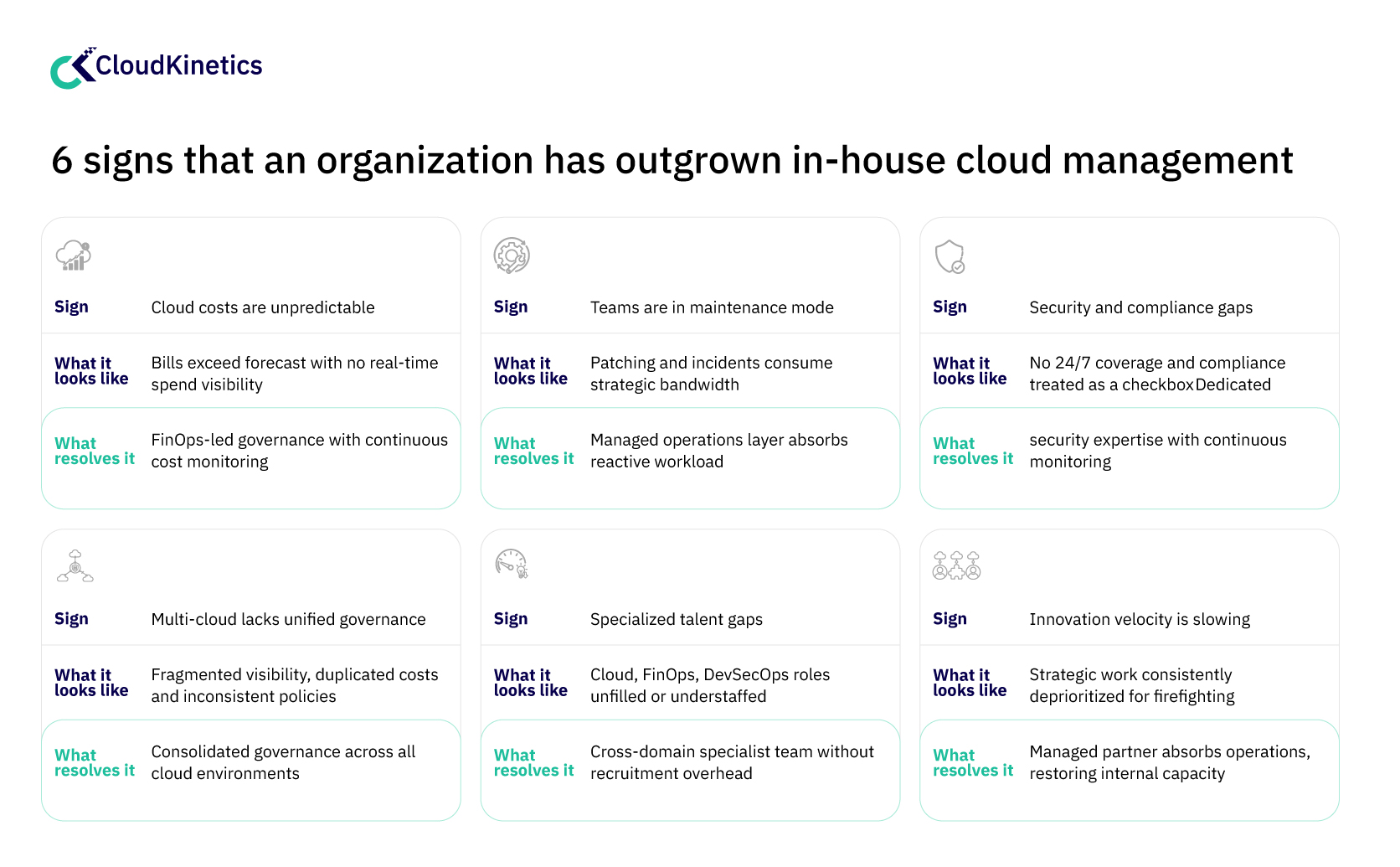
Here are six specific signs that an organization may have outgrown its current in-house cloud management model, covering cost governance, team capacity, security exposure, multi-cloud complexity, the talent gap and innovation velocity.
1. Cloud costs are increasingly unpredictable
Cloud spend management is consistently cited as one of the top challenges for enterprise IT and finance teams. The difficulty is structural, where cloud costs shift with every new deployment, AI workload or unplanned data transfer, making static budgets an unreliable planning tool.
Unlike traditional infrastructure, AI compute costs don’t scale linearly. A single training run or a spike in inference requests can push monthly spend well beyond forecast. Without FinOps processes designed to track workload-level costs, the gap between budget and actuals can widen before it is detected.
Real-time cost visibility and proactive governance, rather than reactive billing review are what allow organizations to manage cloud spend as environments grow in complexity.
2. Teams are spending more time on maintenance
As cloud environments expand, the operational workload associated with patching cycles, alert management and incident response grows alongside them. When that workload absorbs a significant portion of the internal team’s capacity, the time available for architecture decisions, AI readiness and platform modernization decreases.
Research consistently identifies skills and staffing shortages as a direct constraint on the time IT teams can allocate to strategic work. For organizations where this pattern has become deep-rooted, the operational load tends to compound as the cloud footprint grows. This makes it progressively harder for internal teams to move beyond maintenance into higher-value work.
3. Cloud security and compliance require continuous expertise
Cloud security has become a specialized discipline in its own right. Each new service, integration and access point in a cloud environment expands the attack surface and the consequences of a breach extend well beyond the technical. The average cost of a single data breach is $4.88 million.
For organizations in regulated industries, the compliance layer adds further complexity. Frameworks like GDPR, HIPAA and SOC 2 require continuous monitoring, documented controls and audit trails rather than periodic checkboxes. Internal IT teams with broad remits often find it difficult to maintain the depth of coverage these requirements demand, particularly the 24/7 threat monitoring that cloud security now requires.
4. Multi-cloud environments lack unified governance and visibility
Multi-cloud environments typically develop incrementally, with different providers chosen for different workloads, acquisitions bringing in separate cloud footprints or vendor relationships built over time. Each decision may have made sense in isolation.
Managed collectively without unified governance, however, the result is often fragmented visibility, inconsistent security policies and duplicated costs across providers that are difficult to identify without a consolidated view.
A unified operations model covering governance, cost visibility and security posture across all cloud environments is what allows a multi-cloud setup to function as a deliberate strategy rather than a collection of separate decisions.
5. Cloud talent gaps are constraining operational depth
Cloud architects, FinOps specialists, DevSecOps engineers and AI/ML infrastructure leads are among the hardest roles to fill across the technology function, with many organizations reporting open positions that have remained unfilled for over a year.
AI/ML and cybersecurity roles are consistently cited as the most difficult to recruit for. Beyond recruitment, the challenge extends to retention, coverage depth and continuity. A single specialist cannot provide continuous coverage across every domain a cloud environment requires.
As cloud footprints expand to include AI infrastructure, compliance obligations and multi-cloud management, the breadth of expertise needed tends to exceed what a single internal team can realistically cover across all domains simultaneously.
6. Reactive cloud operations are slowing innovation velocity
When security incidents, cost reviews and unresolved hiring gaps consistently absorb engineering and leadership capacity, the time available for new product development, AI readiness and platform evolution decreases accordingly. This tends to be the sign that surfaces because it shows up as a slow accumulation of delayed priorities rather than a single visible event.
Scaling, cost optimization, security and AI infrastructure now frequently need to advance in parallel. For organizations managing all of these internally, the operational workload can crowd out the strategic work, affecting delivery timelines and the pace at which new capabilities reach production.
What these signs are really telling you
These signs reflect the natural progression of cloud environments as they grow in scale and complexity. The management model that works at one stage of growth may not be the right fit at the next.
The decision to bring in managed cloud expertise is not about replacing internal capability. It is about extending into the specialized domains that are most difficult to cover continuously in-house, with security, cost governance, compliance and AI infrastructure. Organizations that make this shift retain strategic ownership of their architecture and roadmap, while gaining operational depth across the domains that demand it most.