IT departments face a tough challenge: managing a growing maze of IT operations while keeping services running smoothly. The complexity of modern tech can overwhelm even experienced professionals, leading to issues like resource allocation problems, checkered operations and compliance headaches.
Imagine a scenario where downtime is common, and IT teams struggle to keep pace with technology changes. Outdated processes and disconnected workflows only make things worse, causing frustration and inefficiency.
IT Service Management (ITSM) can be the solution here.
ITSM provides a way to streamline IT operations and improve service delivery driven by Information Technology Infrastructure Library (ITIL) principles. It encourages the delivery of IT as a service instead of using siloed IT tools and creating information pockets, thus offering a structured approach to managing IT services efficiently and effectively and building the base for AI Ops. With ITSM, organizations can boost efficiency, enable innovation, and tackle the complexities of modern IT systems with confidence.
How ITSM helps streamline operations
1. ITSM is a structured approach that bakes in efficiency
ITSM focuses on identifying and resolving the root cause of incidents, preventing them from recurring. This proactive approach minimizes downtime and ensures a more stable IT environment. Through practices like incident management, problem management, and change management, ITSM ensures that issues are promptly identified, addressed, and resolved, thereby reducing the impact of disruptions on business operations.
By automating routine tasks and standardizing workflows, ITSM helps organizations operate more efficiently, enabling teams to focus their efforts on strategic initiatives rather than firefighting.
2. ITSM focus on user centricity & seamless operations paves way for innovation
The structured approach to managing changes in IT services allows for quicker and more controlled deployment of new technologies and solutions, accelerating innovation cycles.
By incorporating elements such as service design, service transition, and service operation, ITSM encourages IT teams to embrace new ideas, technologies, and methodologies. Through practices like service portfolio management and continual service improvement, ITSM enables organizations to adapt to changing market demands and technological advancements.
With ITSM, we gain the ability to measure performance and boost productivity by pinpointing recurring incidents for automation. Analyzing metrics like MTTR further empowers us to identify skill gaps and refine our knowledge base for continuous improvement.
3. ITSM frameworks drives compliance & security
Effective ITSM practices are essential for addressing regulatory requirements and ensuring robust security measures within organizations. By implementing processes such as configuration management, asset management, and access management, ITSM helps organizations maintain compliance with industry standards and regulations.
Moreover, ITSM frameworks incorporate security management practices that enable organizations to identify and mitigate security risks proactively. By establishing a systematic approach to managing security incidents and vulnerabilities, ITSM enhances the overall resilience of IT infrastructure and safeguards sensitive data from unauthorized access or breaches.
ITSM is not just about managing technology – it streamlines workflows and drives operational excellence, empowering businesses to thrive. By implementing a robust ITSM framework, you can minimize disruptions, effortlessly integrate IT changes, and maximize the utilization of valuable IT resources. ITSM is about efficiency in operations as well as laying the groundwork for sustainable growth and success.
Implementing ITSM: Best practices and strategies
A meticulous strategy is vital in implementing ITSM best practices. Here’s a broader view and a roadmap to move ahead.
1. Assess organizational needs
- ITSM begins with a comprehensive assessment of organizational needs. This involves evaluating current processes, identifying pain points, and understanding specific requirements and challenges.
- By engaging stakeholders across departments, IT leaders can gain insights into business objectives and IT dependencies. This assessment serves as the foundation for designing an ITSM strategy tailored to the organization’s unique goals and circumstances.
2. Select the right tools
- Choosing the appropriate ITSM tools is critical for successful implementation. Organizations should evaluate various ITSM platforms and solutions, considering factors such as functionality, ease of integration, scalability, and cost-effectiveness. It’s essential to select tools that align with the organization’s objectives and can accommodate future growth.
- Additionally, compatibility with existing systems and technologies is crucial to ensure seamless implementation and minimize disruption to operations.
3. Build a framework for success
- Implementing ITSM requires building a framework that aligns with industry best practices and organizational goals. The Information Technology Infrastructure Library (ITIL) framework is widely adopted for its comprehensive approach to ITSM.
- Organizations can leverage ITIL principles to design processes for service strategy, design, transition, operation, and continual improvement.
- Automation plays a key role in optimizing ITSM processes by streamlining workflows, reducing manual intervention, and improving efficiency. By integrating automation tools and technologies, organizations can enhance service delivery, mitigate risks, and drive business value.
ITSM use cases
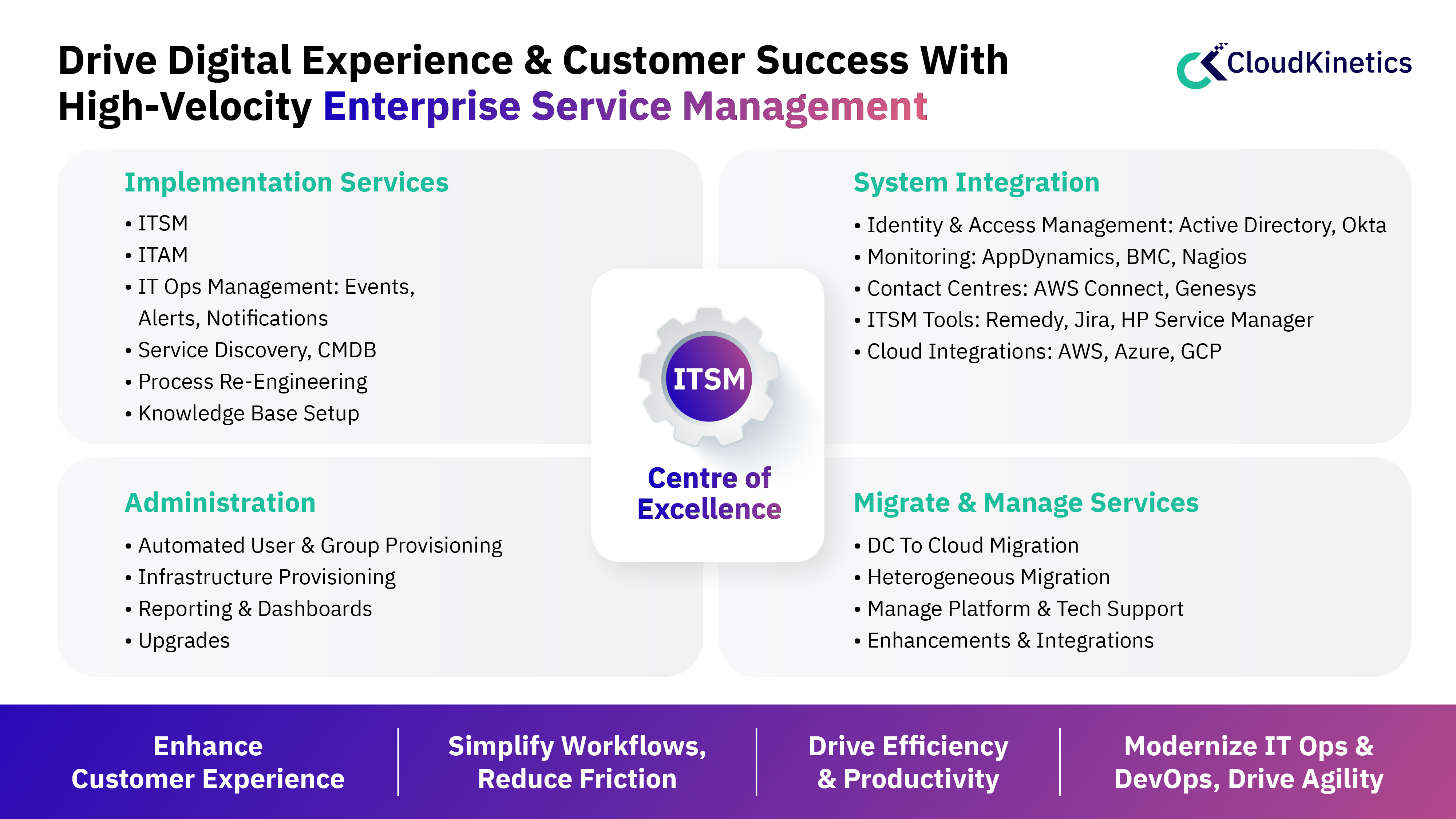
At Cloud Kinetics, we advocate the importance of a comprehensive assessment of your organization’s unique requirements, ensuring seamless alignment between ITSM strategies and overarching business objectives. When it comes to selecting the right tools, prioritize scalability, seamless integration, and intuitive user interfaces to enhance your operational efficiency. Building a successful framework entails setting clear objectives, defining roles and responsibilities, and implementing continuous improvement processes to stay agile.

A leading lifestyle brand sought to transform its ITSM amid challenges with scalability, integration and user experience. We implemented a new ITSM solution, with modules like ITAM, workflow automation, contract management and employee lifecycle support; integrated seamlessly with third-party systems, improved ITSM process adoption and streamlined ticket resolution with ~30% reduction in FTR.

A large colocation provider wanted to streamline global operations amid complex acquisitions and order management challenges. Cloud Kinetics deployed ITSM, ITAM, ITOM and CMDB across multiple regions, integrating with existing applications. The managed services model enhanced SLA compliance, enabled RCA for critical incidents, reduced costs, cut manual effort and improved IT process maturity.
ITSM stands as a transformative force in streamlining IT operations and service delivery. By implementing ITSM methodologies, organizations can enhance efficiency, drive innovation, and ensure compliance and security in their IT processes. ITSM frameworks such as ITIL provide a structured approach to achieving these goals, enabling organizations to adapt and thrive.