Enterprise AI investment continues to accelerate, with significant focus on model selection, benchmarking and vendor evaluation. The data foundation those models depend on often receives less structured attention and gaps in data quality, governance or architecture tend to surface at the production stage rather than during the pilot.
This data strategy roadmap covers the steps that move a GenAI data strategy for enterprises from proof-of-concept into consistent, scalable deployment.
The gap between a successful GenAI pilot and reliable production deployment is almost always a data architecture question.
The reason GenAI projects get abandoned
Gartner projects that 30% of GenAI projects will be abandoned after proof-of-concept, with poor data quality, escalating costs and unclear business value cited as the primary reasons. The underlying pattern is consistent:
data that appears complete at the surface often carries gaps, duplicates or inconsistent formats that only surface when a model is asked to produce reliable outputs at scale.
When outputs are inconsistent, business users lose confidence in the system, and that confidence is difficult to rebuild once it has eroded. The result is that projects are frequently shelved not because the model itself underperformed, but because the data feeding it was not prepared for the demands of production.
Five steps to an enterprise data foundation for GenAI
The state of AI report found that 88% of organizations use AI in at least one business function. The steps below provide a structured path from initial assessment through scaled GenAI deployment:
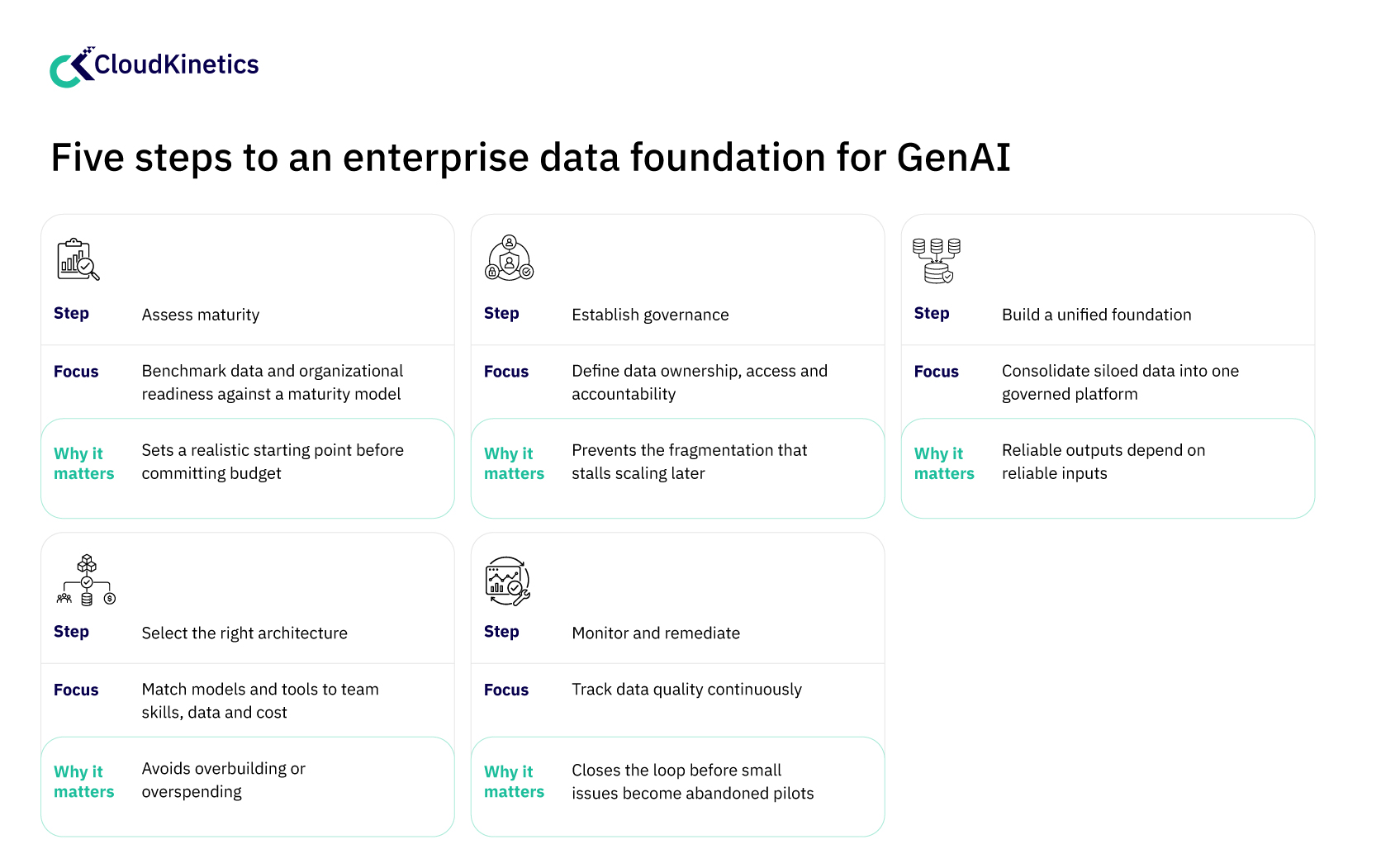
Together, these steps move an organization from experimentation toward the consistency that AI maturity requires.
A practical path to better data quality
Data quality improvement begins with visibility rather than cleanup. Data profiling and lineage mapping establish where data originates, how it changes through systems and where inconsistencies appear. Without this foundation, remediation addresses symptoms rather than root causes.
Ownership structure is a parallel consideration. Two models are common:
- Data stewards: Subject-matter owners responsible for quality within their domain.
- Central platform teams: A shared function setting standards and tooling across the organization.
The two approaches work best in combination, where stewards provide domain context while platform teams maintain consistency across the organization.
Data quality also requires continuous maintenance rather than a single remediation effort. New data entering the system introduces new quality risks over time. Automated monitoring that checks for completeness, duplication and drift addresses issues as they emerge rather than after they affect model outputs.
Tying data quality metrics to specific business use cases, rather than treating quality as a standalone technical goal keeps improvement efforts connected to the outcomes they are meant to support.
Data requirements for AI readiness
Agentic AI has higher data requirements than retrieval-based systems. A question-answering system retrieves information and generates a response, tolerating some latency and imprecision. An agent that takes actions on live systems of updating records, triggering workflows and completing tasks requires real-time, accurate data access to function reliably.
Data governance for AI shifts accordingly. Read-access guardrails that suit retrieval systems are insufficient for agents that act. Clear permissioning of defining what an agent can access, under what conditions and who is accountable for its actions is a prerequisite for safe agentic deployment.
According to Gartner, 80% of GenAI business applications will be built on existing data management platforms rather than custom infrastructure. The retrieval-augmented generation (RAG) and orchestration layers many enterprises have already invested in form the foundation that agentic AI builds on next.
Unstructured data readiness
Enterprise data strategies have historically focused on structured data of tables, columns and rows that fit neatly into relational databases. A significant portion of enterprise knowledge, however, exists in unstructured formats: documents, emails, call transcripts, images, video and audio. GenAI and multimodal AI depend on this data being processed and made accessible. That requires purpose-built pipelines:
Document parsing: Extracting text and structure from PDFs, contracts and scanned files.
Image and video embeddings: Converting visual content into a format models can search and reason over.
Audio transcription: Turning calls and recordings into searchable and structured text.
Metadata tagging: Adding context so content can be retrieved accurately.
The GenAI data strategy roadmap
A readiness framework identifies what needs to be in place. A roadmap provides a sequenced path for getting there. Below is a milestone-based structure that moves from initial assessment through scaled deployment:
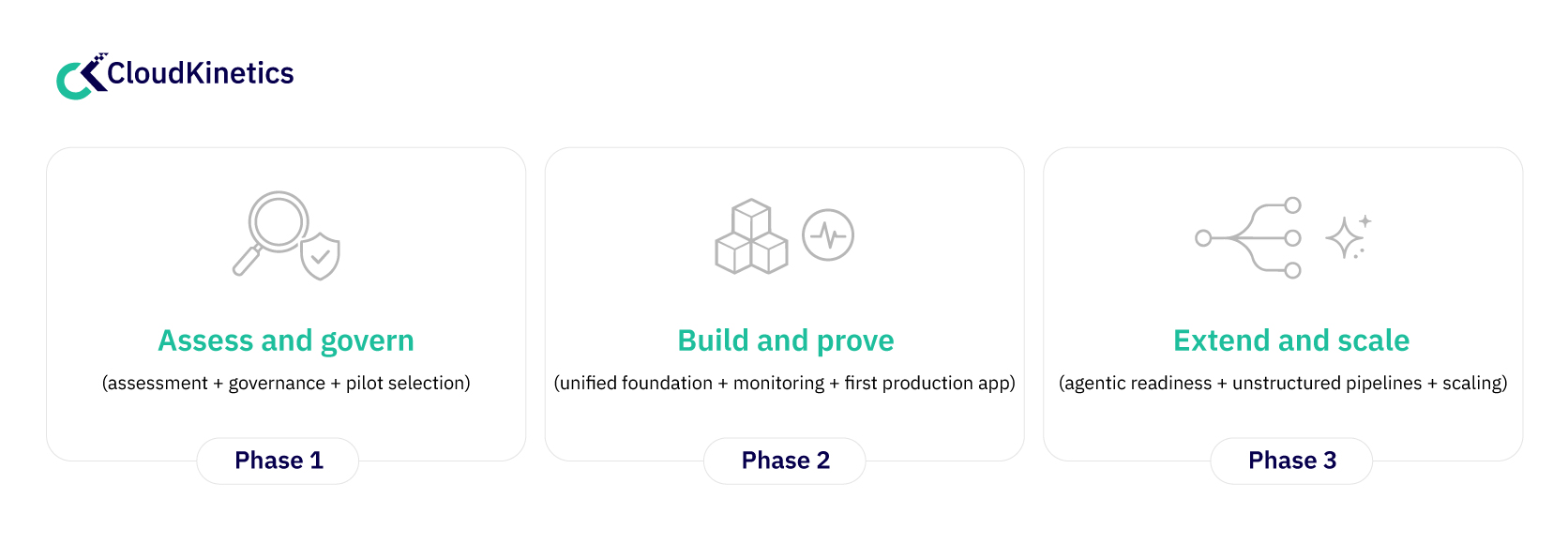
The sequencing is deliberate. Moving to scale before the governance and data quality foundation is established tends to surface the same gaps that cause proof-of-concept projects to stall.
A GenAI data strategy is an ongoing operating discipline of governance, data quality and infrastructure readiness maintained continuously rather than addressed once at the pilot stage. Organizations that build this discipline into how they operate are better positioned to move AI initiatives from experimentation into consistent production deployment.
The data foundation is where that work begins. Governance, agentic readiness and unstructured data pipelines all depend on that foundation being reliable and governed before they are built on top of it.