
APAC is one of the fastest-growing AI markets globally, with investment expected to reach $437 billion and continuing to grow at 9.3%. The architecture frameworks informing many enterprise AI programmes were developed in contexts with consolidated cloud regulation, one or two dominant languages and mature digital infrastructure. Across much of APAC, those conditions vary significantly by market.
The five regional factors below are where the difference between global architecture assumptions and local operating conditions shows up most consistently, and where decisions made at the design stage have the most direct effect on whether a programme is legally operable, linguistically capable and practically deployable.
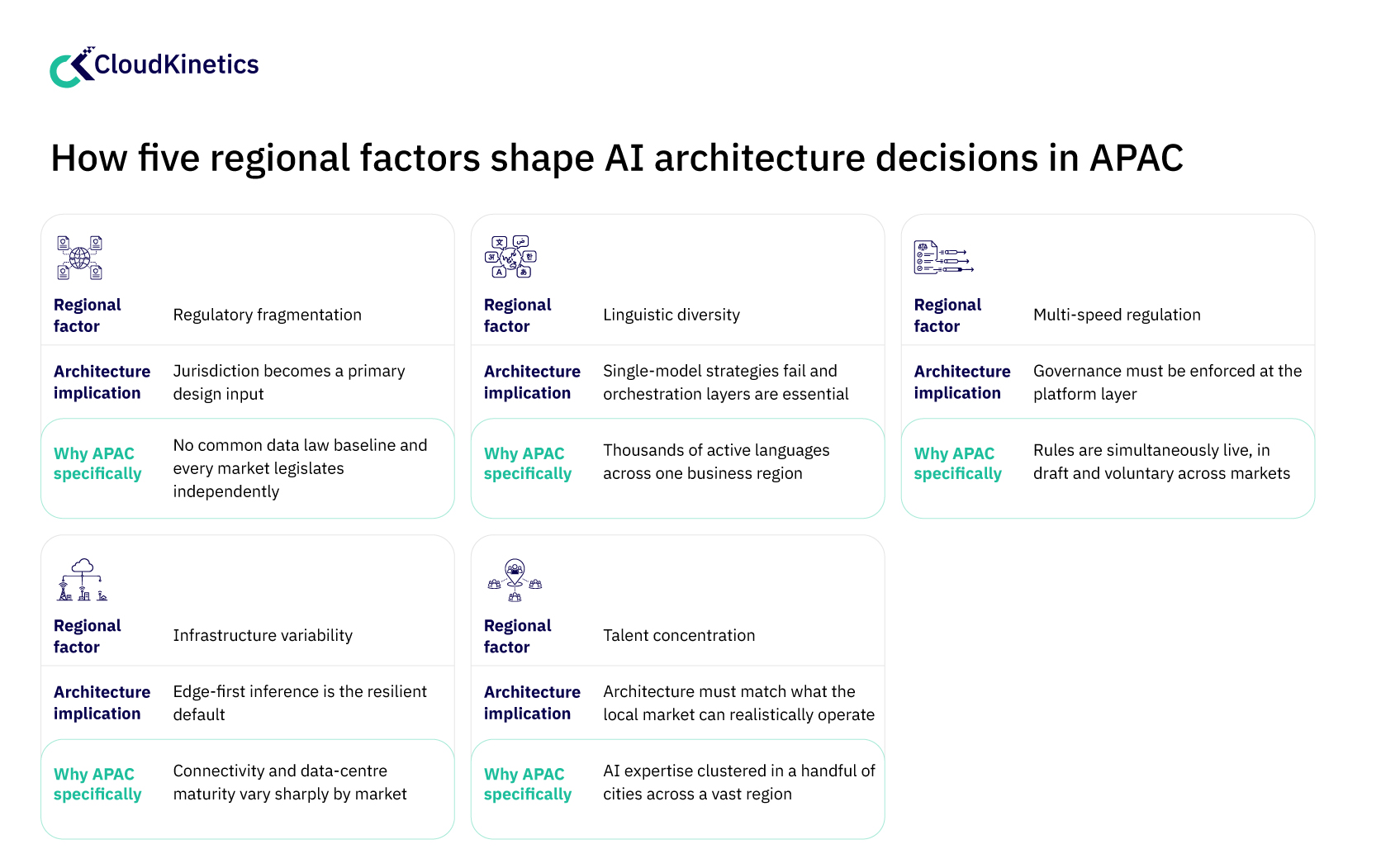
In APAC, the regional factors that shape AI architecture of regulation, language, infrastructure and talent are not secondary considerations. They are primary design inputs.
1. Regulatory fragmentation: No common data law baseline across markets
In Europe, GDPR gave enterprises a single compliance baseline to build against. In the US, federal frameworks provide a common reference point. APAC has neither. Each market has legislated independently, on its own timeline, with its own definitions of what constitutes personal data, where it can be stored and what triggers a reportable breach.
India’s Digital Personal Data Protection Act, Vietnam’s Personal Data Protection Law, Singapore’s updated Personal Data Protection Act and Australia’s tightened breach-reporting rules are four examples of frameworks that share a broad intent but diverge sharply in their requirements. None of them are converging. As each market continues to legislate, the gap between what one jurisdiction requires and what another permits is widening. This means that an architecture built to satisfy today’s requirements in one market may create exposure in another when its next legislative update passes.
The result is that 86% of APAC enterprises are now running hybrid AI models, pulling sensitive workloads back from public cloud into on-premises or in-country infrastructure. A cloud contract negotiated at global headquarters may not account for the level of per-market specificity that APAC data residency laws now require. Sovereign retrieval-augmented generation (RAG) deployments, in-country data centre commitments and per-jurisdiction access controls are becoming standard architecture considerations rather than exceptions.
Reviewing the current cloud footprint against data residency requirements by market and identifying which workloads handle sensitive data and where they currently sit provides the basis for understanding where regulatory exposure may already exist. A hybrid architecture review that treats jurisdiction as a design constraint is the structural response.
2. Linguistic diversity: Thousands of languages create model reliability gaps
The language landscape across APAC is unlike any other region an enterprise is likely to operate in. Thousands of distinct languages and dialects are in active use across markets that sit within the same regional business footprint. The challenge this creates is a model reliability risk.
Foundation models trained predominantly on English-language data handle tonal languages inconsistently and can miss cultural context that affects how outputs are interpreted. In customer-facing or compliance-sensitive applications, this inconsistency can affect accuracy and trust in ways that are not always visible until they affect user outcomes.
Enterprises across the region are responding by building model orchestration layers that route queries based on language, jurisdiction and use case rather than sending everything to a single global model. A legal query in Singapore might go to a locally compliant sovereign model. A customer service interaction in Indonesia should be routed differently from one in Australia.
Countries are already developing indigenous options to support this, like Singapore’s National Multimodal LLM Programme and Indonesia’s Sahabat AI. The RAG versus fine-tuning decision also lands differently here, with low-resource languages common across ASEAN often lacking the training data volume required for fine-tuning.
Identifying which languages and markets current AI systems touch and where output quality is inconsistent is a practical starting point for determining where an orchestration layer would have the most immediate value.
3. Multi-speed regulation: Governance frameworks at different maturity stages
Agentic AI systems can execute workflows that cross jurisdictional boundaries. A single automated transaction may originate in one APAC market, trigger a compliance check in another and log a decision in a third, without a human review at each step.
In regions with a common regulatory baseline, this is a manageable design challenge. In APAC, where each market governs AI independently and at a different pace, it is a more complex one. MAS has published specific auditable AI expectations for financial institutions in Singapore. Australia is still finalizing its AI obligations. ASEAN’s framework is advisory rather than enforceable. For an enterprise running agentic workflows across these markets simultaneously, compliance posture varies significantly across the same deployment.
In architectural terms, identity controls, audit trails and autonomy boundaries are most reliably enforced at the platform layer built into how agents authenticate, act and escalate, rather than managed through governance documentation that agents do not consult before acting. With Gartner projecting that 40% of enterprise software will embed task-specific AI agents, governance infrastructure designed for static policy documents is unlikely to keep pace with that rate of deployment.
4. Infrastructure variability: Connectivity and capacity differ sharply by market
Infrastructure maturity varies significantly across APAC markets. Designing AI architecture around a uniform infrastructure baseline without accounting for that variation can create operational challenges that are difficult to address after deployment.
Vietnam, Malaysia and Indonesia are absorbing significant investment, but their cloud infrastructure is not at parity with mature markets. Subsea cable disruptions are documented, last-mile connectivity is uneven and data-centre capacity is still building out. India’s infrastructure push is substantial, where a $100 billion data-centre build is underway, but that capacity arrives in phases over several years.
The architecture implication is direct. Routing all AI inference through centralized cloud data centres makes operations vulnerable to the connectivity conditions that actually exist in these markets. Running inference at the edge, while using the cloud for model training, updates and governance, keeps AI systems available and performant even when network conditions are not ideal.
Designing for current infrastructure conditions with deliberate upgrade paths for what arrives over the next 24 months tends to produce more resilient outcomes than designing for an assumed infrastructure state that has not yet materialized.
5. Talent concentration: AI expertise is clustered in a few cities across a vast region
AI and data engineering talent in APAC is geographically concentrated largely in Singapore, Bangalore, Sydney and Shanghai, while many of the markets where enterprises are expanding have limited local supply. Competition for that talent is significant, with hyperscalers, government AI programmes and well-funded fintechs drawing from the same pool.
For most enterprises, building a large internal AI platform team across APAC markets is not a near-term option in most locations. Architecture that requires deep internal ML expertise to operate is difficult to sustain in markets where that expertise is hard to hire or retain.
Managed AI services, partner-led MLOps and platform engineering approaches that reduce operational burden on internal teams are the practical direction for many APAC deployments. Architecture choices that prioritize operational simplicity alongside capability tend to be more sustainable in this talent environment.
Skill gaps are frequently cited ahead of budget or tooling as a barrier to scaling AI agents across the region. Architecture decisions that account for talent availability around managed services and partner-led approaches have a direct bearing on how quickly that constraint can be addressed.
What APAC-ready AI architecture actually looks like
None of these five factors exists in isolation. Regulatory fragmentation shapes which cloud model is viable. The cloud model affects which AI models can be deployed. Model selection determines what governance controls are needed. Governance requirements influence where inference can run. And all of it depends on what the talent market in each specific location can realistically support.
Architecture that treats these regional realities as primary design inputs, rather than variables to be adjusted after the core design is set, is what produces AI programmes that are legally operable, linguistically capable and operationally sustainable across one of the world’s most diverse markets.