The window between vulnerability disclosure and active exploitation has narrowed considerably in recent years. For organizations running mission-critical workloads on the cloud, this acceleration has raised the stakes around detection speed, response capability and governance structure.
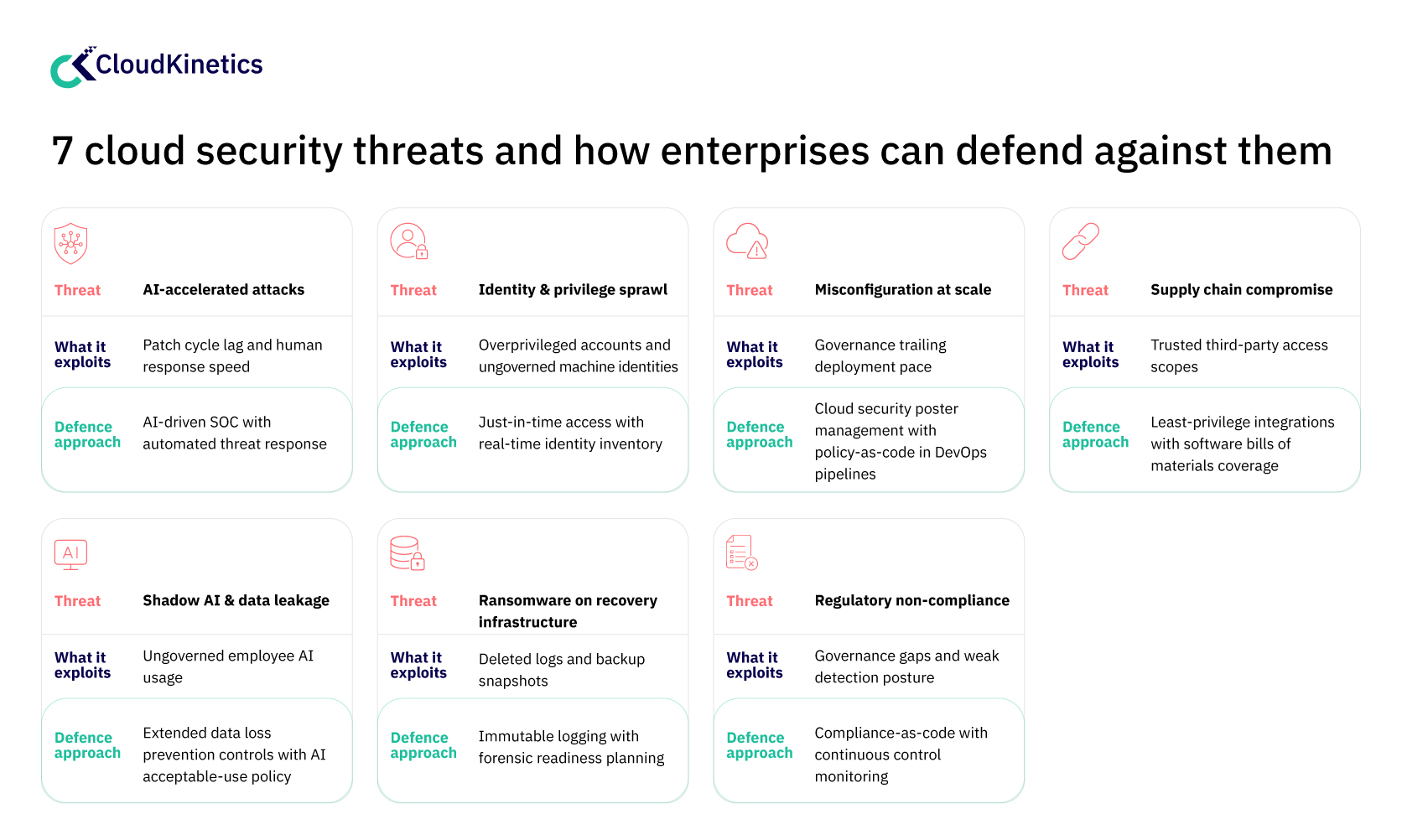
The seven threats below are active and documented. Each has implications that extend beyond the security team into financial reporting, regulatory standing and organizational resilience.
The organizations best positioned against today’s cloud security threats are enforcing controls earlier, governing access more accurately and treating resilience as a planned capability.
AI-powered attacks and automated exploitation
AI tools are now in use on both sides of the security equation. Google Cloud’s threat intelligence confirms the arrival of sustained, automated campaigns where agentic AI discovers and exploits vulnerabilities faster than traditional patch cycles can respond.
The exploitation window has narrowed from weeks to hours in documented cases. Beyond accelerating exploitation, AI is also accelerating targeting through voice cloning to impersonate executives, prompt injection attacks on enterprise AI systems and deepfakes that undermine identity verification. Structurally, this puts pressure on security operations to match attacker tempo.
Modern security operations centre (SOC) models are increasingly incorporating AI agents for alert grouping, anomaly detection and response initiation, allowing analysts to focus on judgment-intensive decisions.
Identity sprawl and overprivileged access
The Snowflake breach illustrates the access risk pattern clearly, where attackers used legitimate credentials, with no multi-factor authentication in place and no anomaly detection triggered, to compromise hundreds of organizations. No exotic malware was required.
Qualys’ cloud security research identifies the structural conditions that enabled it. Identities carrying more access than required, trust relationships extending beyond defined boundaries and exposure persisting longer than intended. A second dimension worth noting is that machine identities like service accounts, API keys and CI/CD pipeline tokens now outnumber human ones in enterprise environments and frequently lack the same inventory and governance controls applied to human access.
Zero Trust architecture addresses this through continuous identity verification and least-privilege enforcement, rather than static access reviews. A practical starting point is maintaining a real-time inventory of all identities, including human and machine, with standing access to production cloud environments.
Cloud misconfiguration and governance gaps
Misconfiguration is the most consistently documented entry point in cloud breach reports, not because it requires sophisticated attackers, but because cloud environments evolve faster than manual governance can keep pace with. The average enterprise cloud account carries 43 misconfigurations, a figure that compounds across hybrid and multi-cloud estates with each new service provisioned.
Misconfigurations rarely surface on their own. They tend to appear during breach investigations, compliance audits or penetration tests. Cloud security posture management (CSPM) tools close the visibility gap, and policy-as-code embeds guardrails directly into DevOps pipelines. This helps in catching misconfigurations before resources reach production rather than after.
Supply chain and third-party integration risk
IBM’s X-Force analysis documents a shift in attacker focus, away from hardened enterprise perimeters toward identity providers, administrative consoles and SaaS platforms that already have standing access to enterprise environments. IBM found supply chain incidents increased nearly 4 times over five years.
The structural challenge is the trust architecture that enterprise integrations create. Each connection between CRM, data warehouse, CI/CD pipeline and production systems carries an access scope that may extend further than intended when mapped across the full environment.
Third-party risk management is evolving to reflect this. Effective approaches include mapping actual cloud access scopes rather than relying on questionnaire-based assessments, applying least-privilege principles to each integration and extending software bills of materials (SBOMs) to cover cloud-adjacent services.
Shadow AI and unsanctioned data sharing
Shadow AI refers to the use of unsanctioned AI tools by employees. This includes summarizing sensitive documents, pasting source code into browser extensions or processing customer data through platforms outside IT governance.
Nearly 78% of organizations reported confirmed or suspected AI-related security incidents recently, with many tracing back to internal usage that outpaced governance frameworks rather than external attackers. The governance gap here is structural.
Data loss prevention (DLP) policies written before enterprise AI tools existed were not designed to cover AI endpoints. Addressing shadow AI risk involves extending DLP controls to cover AI tool usage, establishing access governance that distinguishes approved tools from unsanctioned ones and maintaining acceptable-use frameworks that are current and clearly communicated.
Ransomware targeting recovery infrastructure
Ransomware has evolved beyond data encryption. Google Cloud’s threat horizons report documents a deliberate shift in attack behavior. Before triggering the payload, attackers systematically delete logs, core dumps and backup snapshots. This creates two concurrent crises: the operational challenge of restoring systems and a regulatory one that follows.
GDPR and similar frameworks require documented evidence of what data was accessed during a breach. Without intact logs, producing that evidence becomes difficult. Immutable logging and forensic readiness of knowing in advance how an attack timeline would be reconstructed are increasingly treated as legal defensibility requirements.
Regulatory non-compliance as a security risk signal
Compliance posture has become a factor in how organizations are targeted. Non-compliant environments are associated with weaker detection capability and less rigorous governance, conditions that reduce the effort required to maintain undetected access. The board-level dimension is equally relevant. There is a growing expectation for security risk to be expressed in financial terms, quantified exposure.
Compliance-as-code addresses the operational side through continuous control monitoring, automated evidence collection and real-time dashboards that surface drift before an audit cycle. The strategic shift is in framing security investment in terms of quantifiable business risk, which is the language through which cloud security decisions increasingly reach board-level scrutiny.
The real security challenge is architectural
Across all seven threats, a consistent pattern emerges. The conditions attackers exploit with overprivileged identities, ungoverned integrations, misconfigured resources and gaps in recovery infrastructure. These are addressable before an attack occurs.
The shift in security posture that addresses these threats most effectively is structural. Moving security controls earlier in the development and deployment cycle, extending governance to cover AI tools and third-party integrations, along with building forensic readiness as a planned capability. These are architectural and organizational decisions, and they carry implications that extend beyond the security team into regulatory standing, financial exposure and organizational resilience.