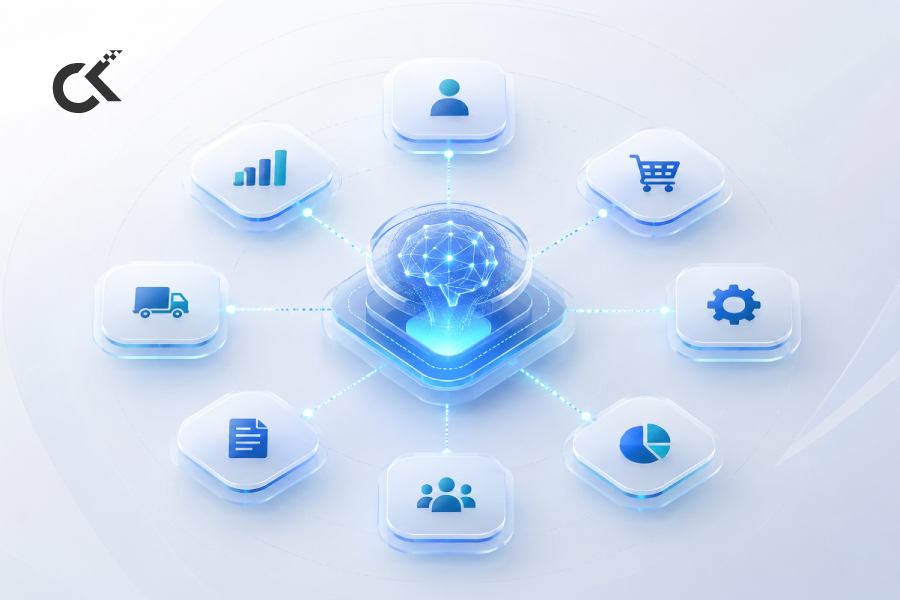
Enterprises are adopting GenAI to improve team productivity. Agentic AI extends that further by making operations more autonomous and acting on decisions rather than waiting to be prompted. That distinction is showing up across IT operations, finance, supply chains, customer experience, security, engineering and HR.
The 7 enterprise use cases below illustrate where agentic AI is moving from early deployment into measurable business outcomes, framed around the decisions that matter at the enterprise level.
Productivity gains from AI are well documented. The next frontier is AI that acts by completing workflows, resolving issues and escalating only what genuinely needs human judgment.
The case for agentic AI in your operating model
Most enterprises are entering the new world of technology with a growing AI portfolio that includes chatbots, copilots and GenAI assistants. There is a 95% failure rate for enterprise GenAI projects, defined as those that do not show measurable financial returns within six months. Meanwhile, 61% of senior business leaders now feel more pressure to prove AI ROI than they did a year ago.
GenAI responds and generates, but it does not act autonomously. As direct financial impact like revenue growth and margin improvement replaces productivity as the primary AI ROI metric, enterprises are looking for where AI can do more than assist.
Agentic AI addresses that gap. The 7 use cases below show where autonomous AI is already delivering that kind of operational impact.
1. Autonomous IT operations (AIOps)
The average IT operations team receives 500 to 1,200 alerts per day, and most of that time is spent not on fixing what matters. AI automation in enterprise IT operations changes the model entirely. Instead of humans chasing incidents, enterprise AI agents monitor infrastructure continuously. It correlates anomalies across systems, executes pre-defined remediation runbooks and escalates only what genuinely needs human judgment. The result is less firefighting, more engineering.
When agents handle incidents that follow predefined remediation patterns, engineering capacity shifts toward higher-order work, involving system design, performance improvement and architecture decisions.
2. Intelligent finance & compliance automation
Autonomous AI workflows handle the operational weight of finance without much lag. Reconciliation runs continuously. Regulatory reports are generated as transactions occur. Fraud signals get flagged and acted on in milliseconds, not hours after a threshold is manually reviewed. And every action leaves a clean, timestamped audit trail by default.
One data point worth noting is that more than 61% of CFOs in a Salesforce survey reported that AI agents are already changing how they evaluate ROI. This includes moving beyond traditional metrics toward broader business outcomes. In most enterprises, finance functions have been among the earlier adopters of agentic AI, driven by the volume, repeatability and audit requirements of core finance workflows.
3. Autonomous supply chain orchestration
Many supply chain operations still rely on periodic planning cycles and manually triggered responses to disruptions. Agentic AI makes continuous orchestration possible by connecting planning, logistics, procurement and manufacturing on a shared, real-time data foundation. That shift is what intelligent agents in business make structurally possible.
When a supplier signals a delay, agents don’t wait for a planner to notice. They evaluate alternatives, trigger a revised purchase order, adjust inventory forecasts and update downstream fulfilment in minutes. Gartner predicts 60% of supply chain disruptions will be resolved without human intervention by 2031
4. Hyper-personalized customer experience at scale
Contact centre queues carry a significant volume of interactions that are high in frequency but low in complexity. This includes billing queries, order status checks, account updates and routine service requests. Staffing those interactions at scale carries a cost ceiling that is difficult to sustain as volume grows.
Enterprise AI agents don’t just speed up those interactions. It restructures who handles them. Agents read intent, pull customer history, execute backend actions and resolve issues end-to-end without a human in the loop. What reaches your service teams is what actually needs them, including judgment calls, sensitive cases and relationship moments.
The numbers back it up. When Cloud Kinetics deployed a customer support AI agent for an American telecom company, it delivered 92% first-contact resolution and 99.5% uptime. The team is now able to handle high enquiry volumes around the clock without adding headcount.
5. Agentic cybersecurity & threat response
Security operations centres managing high alert volumes face a response time gap that agentic AI can help close. Autonomous AI workflows investigate signals, execute containment actions and escalate only what requires human judgment, without waiting in an analyst queue.
Rather than flagging threats for analysts to investigate, these autonomous AI workflows investigate independently. They correlate signals across environments, execute containment actions and escalate only what demands human judgement.
73% of cybersecurity teams are already using or actively developing agentic AI within their security operations. For executives, the strategic value is coverage that no headcount model can replicate.
6. Accelerated software development & DevOps
Engineering time in most organizations is distributed across more than just building. Pull request backlogs, manual test cycles and deployment monitoring each draw on the same pool of capacity. The code gets written, but the pipeline slows everything else down.
Agentic AI operates across the full development lifecycle, running test loops, monitoring CI/CD pipelines and leading first-pass incident response with full context from the codebase.
What changes for executives is where engineers actually spend their time. Routine execution moves to agents. Architects and senior engineers shift toward system design, trade-off decisions and oversight. TELUS, for instance, used agentic coding tools to ship engineering output 30% faster while saving over 500,000 engineering hours.
7. Autonomous HR & talent operations
In HR, agentic AI enables end-to-end process automation across functions that currently rely on manual coordination. A new hire triggers an agent that provisions system access, schedules orientation, routes benefits enrollment and handles policy queries in real time across departments, without manual handoffs. Workforce analytics surfaces flight risks before resignations land.
The compliance dimension matters just as much. Agents generate audit trails, flag regulatory inconsistencies and enforce policy consistently across geographies, something human-run processes rarely achieve at scale.
Where should your organization start?
Three considerations tend to identify the strongest starting point for an agentic deployment.
- The first is where skilled people are spending time on high-volume, repeatable work that does not require their judgment.
- The second is whether the underlying data is already reliable, connected and moving in real time. Agentic AI performs in proportion to data quality.
- The third is whether improving the process would move a metric that leadership is already tracking. The intersection of those three factors tends to produce the fastest time-to-value and the clearest internal case for scaling further.
Getting that intersection right depends as much on your cloud and data foundation as it does on the AI itself.