Cloud environments scale quickly by design and that flexibility creates value for enterprises managing variable workloads. It also means that spend can grow in ways that outpace governance if the underlying usage patterns are not reviewed regularly.
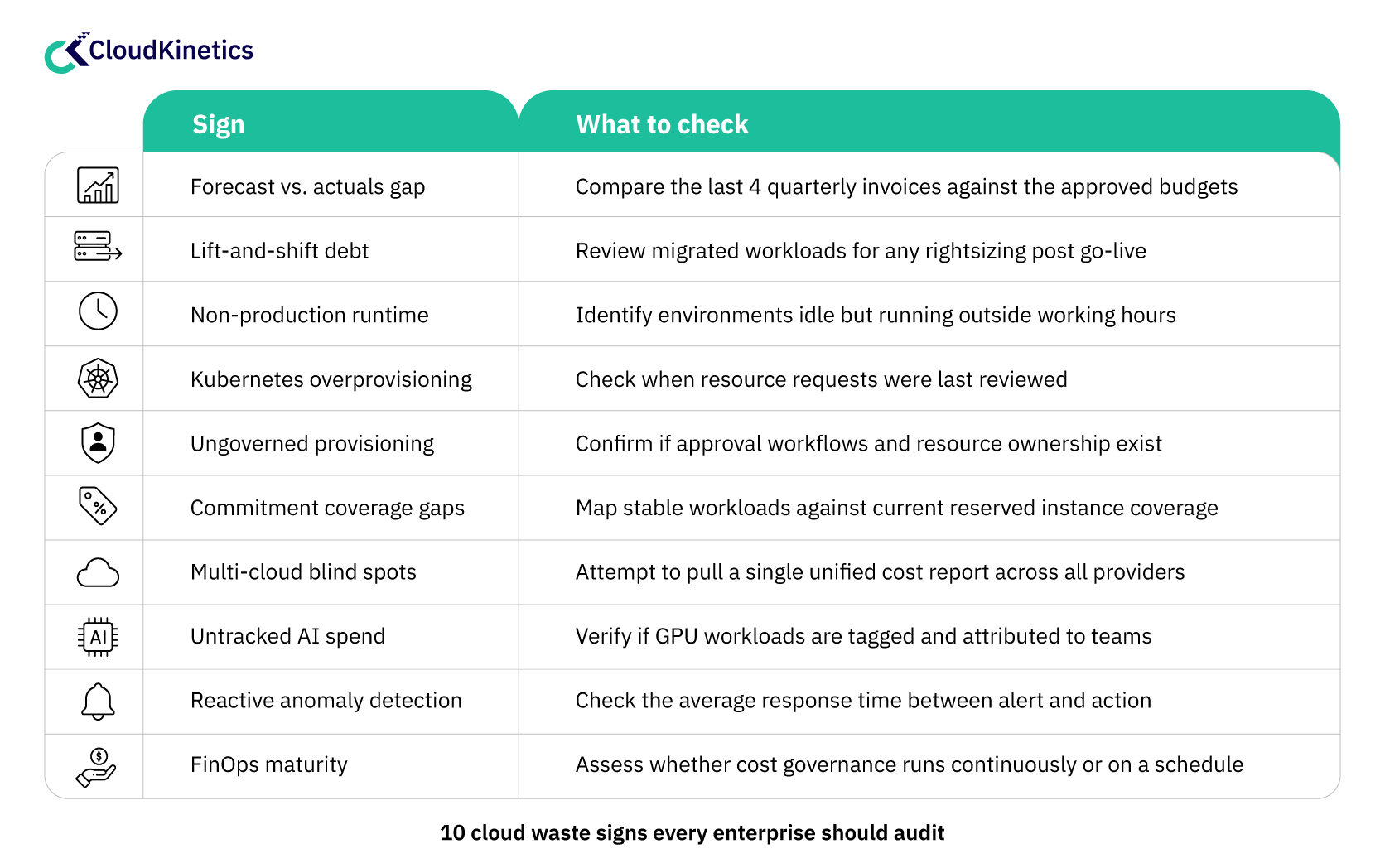
An estimated 21% of enterprise cloud infrastructure spend goes to underutilized resources, a figure that compounds across providers and workloads at scale. This checklist covers ten signs of potential overspending, structured as a working self-assessment for enterprise teams reviewing their cloud cost posture. If you recognize more than three, the next step can be an audit.
Cloud spend that outpaces forecasts is rarely the result of a single decision. It accumulates across provisioning habits, deferred optimizations and workloads that were never formally reviewed.
1. Cloud spend consistently exceeds forecast
You approved a cloud budget, but the actual bill arrived higher again. If this has become a pattern, the problem can be a broken forecasting model.
Cloud spend does not behave like a fixed cost. Rather, it shifts with every new deployment, data transfer and service launched outside a formal request process. When forecasts are consistently off, it typically points to a budgeting model built on static assumptions that no longer reflect how the environment actually operates. Reviewing the assumptions behind the cloud budget, not just the totals, is where the gap usually surfaces.
2. Migrated workloads were not optimized post-migration
Workloads migrated as-is often retain the architecture patterns suited to on-premise environments. That means fixed resource allocation, always-on compute and configurations designed for peak rather than average load. In a pay-per-use model, those patterns have a direct cost implication. A review of migrated workloads against current cloud-native design principles is a practical way to identify where re-architecting would improve the cost-to-performance ratio.
3. Non-production environments run outside working hours
Even after the developers log off, the test environments still run. Somewhere in your cloud estate right now, there are staging servers, test databases sitting idle and load balancers pointing to workloads that haven’t been touched. They are running and are billing.
Non-production environments often run continuously without a clear owner accountable for their uptime outside working hours. At enterprise scale, the accumulated cost of idle non-production infrastructure is material. Scheduling these environments to run only during active hours is a governance decision with a direct impact on the bill and minimal operational disruption.
4. Kubernetes resources are overprovisioned
Kubernetes delivers infrastructure efficiency when resource configurations are actively maintained. In practice, resource requests are often set conservatively at go-live and not revisited as actual usage patterns stabilize. Research indicates Kubernetes infrastructure is overprovisioned by as much as 40% in many enterprise environments, a waste that does not surface in standard billing dashboards because the spend appears normal while utilization remains low. Regular reviews of requested versus actual resource consumption are where this gap is typically identified.
5. No formal approval or ownership process for provisioning
Cloud provisioning is designed to be fast and accessible, a core part of its operational value. Without corresponding governance, however, resources can accumulate across teams without clear ownership or decommissioning processes. Role-based access controls and lightweight approval workflows ensure that what gets created also gets assigned to an owner, making it easier to track, review and retire resources when they are no longer needed.
6. Stable workloads are still on on-demand pricing
Every cloud provider offers a straightforward deal involving a commitment to predictable usage upfront, and paying significantly less for it.
Reserved instances and savings plans offer meaningful discounts for workloads with predictable, consistent usage. Without clear visibility into which workloads are stable versus variable, commitment decisions tend to be deferred and on-demand pricing continues to apply to infrastructure that would qualify for a lower rate. Mapping stable workloads against current commitment coverage is a practical starting point for identifying where savings plan utilization can be improved.
7. No unified cost view across cloud providers
Multi-cloud environments often develop incrementally through acquisitions, workload-specific decisions or provider relationships built over time. Each provider operates its own billing format, pricing logic and optimization tooling. Without a unified view across providers, cost patterns that would be visible in aggregate stay hidden, and anomalies on one provider can go undetected while another is being actively managed.
8. AI and GenAI workloads are not tagged or attributed
GenAI workloads behave differently, scale unpredictably and run on infrastructure that costs significantly more than standard compute. Traditional cost tracking tools were not designed to attribute GPU spend to specific teams, products or outputs. This makes it difficult to assess whether AI workloads are delivering value relative to what they cost.
What gets missed is the accumulated cost of AI workloads that were never tagged, attributed to a team or product and reviewed against the value they actually delivered. Tagging AI workloads separately and reviewing them against defined output metrics is how enterprises build a clearer picture of AI cost efficiency.
9. Cost anomalies are detected after spend has occurred
There is a meaningful difference between a cost monitoring system and a cost management system. One tells you what happened and the other helps you intervene before it does.
Management enables intervention before spend has already occurred. Alert configurations that are reviewed regularly with clear ownership and response thresholds are more likely to surface anomalies in time to act on them, rather than explain them after the invoice arrives. Effective cost governance should be designed in a way that your team knows about a problem before the invoice confirms it.
10. Cost governance operates on a review cycle
Establishing a FinOps function is a starting point, not an end state. Organizations at the earlier stages of FinOps maturity tend to identify and address obvious waste effectively. Systematic prevention, where cost governance is embedded into provisioning decisions rather than reviewed after the fact, typically develops as the practice matures and cross-team accountability structures become more established.
A FinOps practice at the “walk” stage catches obvious waste, but does not systematically prevent it. Optimization happens in cycles, and by the time the review lands, the opportunity to act has often passed.
The reality check: Why is the bill still growing?
Cloud waste rarely concentrates in one place. It distributes across teams, providers and workloads and it tends to compound when governance operates on a review cycle rather than continuously. You need to identify structural inefficiencies across compute, storage, multi-cloud environments and AI workloads. This includes areas that standard tooling routinely misses. For teams looking to move beyond surface-level visibility into actionable cost governance, a structured cloud waste assessment is a practical starting point.
The checklist above is a starting point for identifying where structural inefficiencies are most likely to be accumulating and which areas warrant a closer look. Ticking more than three signs here is the norm for enterprises at scale.