Agentic AI is not an upgraded version of Robotic Process Automation (RPA). The two technologies solve different classes of problems and are built on different architectures, a distinction that matters when evaluating which one a given process actually needs. Gartner has flagged a related pattern, warning against “agent washing”, vendors rebranding legacy RPA as AI agents when true agentic AI requires goal-oriented reasoning, cross-app orchestration and persistence that distinguish it from scripted automation.
Discover the practical differences between RPA and agentic AI, where each fits and the factors that determine which layer a given enterprise process requires.
RPA and agentic AI operate as complementary layers. One executes deterministic steps, the other manages orchestration and exception-handling when the situation shifts.
RPA: Rule-based Automation For Structured Tasks
RPA runs on predefined rules. A bot follows fixed steps, including click here, copy this field and paste it there exactly as programmed, every single time. It doesn’t interpret context and make judgment calls. It executes.
This predictability is why RPA delivers consistent value in specific enterprise settings.
- Predictability: The same input produces the same output, every cycle. For processes like payroll runs or invoice matching, this consistency matters more than flexibility.
- Auditability: Every action a bot takes is logged step by step. For finance and compliance teams, that logged trail directly supports audit and regulatory reporting.
- Lower cost of ownership: Once a workflow is stable, RPA bots require minimal retraining or oversight. There is no model drift to manage and no reasoning layer to monitor.
Structured, high-volume rules-based work remains a significant part of enterprise operations and the RPA software market, which grew 14.5% to $3.6 billion, reflects that continued demand even as the automation landscape has broadened.
Agentic AI: Reasoning-Based Systems Built For Unstructured Work
As an autonomous AI enterprise capability, agentic AI works differently from scripted automation at the architecture level. Instead of following a fixed sequence of steps, it uses a large language model as a reasoning engine. Rather than executing a pre-written sequence, the system determines its next action based on what it finds at each step.
This changes what the system can handle. A scripted workflow needs the input format defined in advance, a specific field or a specific file structure. An agentic system can work with unstructured inputs like an email thread, a support ticket written in plain language or a document with no fixed template. It plans a path toward the goal rather than executing one that was already written for it.
The shift in enterprise investment reflects this capability gap. Gartner forecasts AI agent software spending will reach $376.3 billion, up from $86.4 billion in the previous year.
Agentic AI vs RPA: A Direct Comparison
This intelligent automation comparison lays out where the two technologies diverge across six operational dimensions.
| Dimension | RPA | Agentic AI |
| Decision-making capability | Follows fixed if-then rules with no independent judgment | Reasons through a goal, weighs options and chooses a path |
| Handling of unstructured data | Requires structured, template-based input | Processes free text, documents and varied formats directly |
| Adaptability to exceptions | Fails or halts when an input falls outside the script | Adjusts its approach when the situation changes mid-task |
| Implementation complexity | Lower, maps existing steps into a bot | Higher, requires defining goals, guardrails and tool access |
| Cost profile | Lower upfront cost and stable maintenance cost | Higher upfront investment, cost tied to reasoning volume |
| Governance or audit needs | Simple, every step is logged in sequence | More involved, requires oversight of decisions |
Why RPA Remains The Right Tool For Certain Processes
Three categories of enterprise work continue to suit RPA. ot because agentic AI cannot handle them, but because the processes themselves are stable, rule-bound and already well-defined:
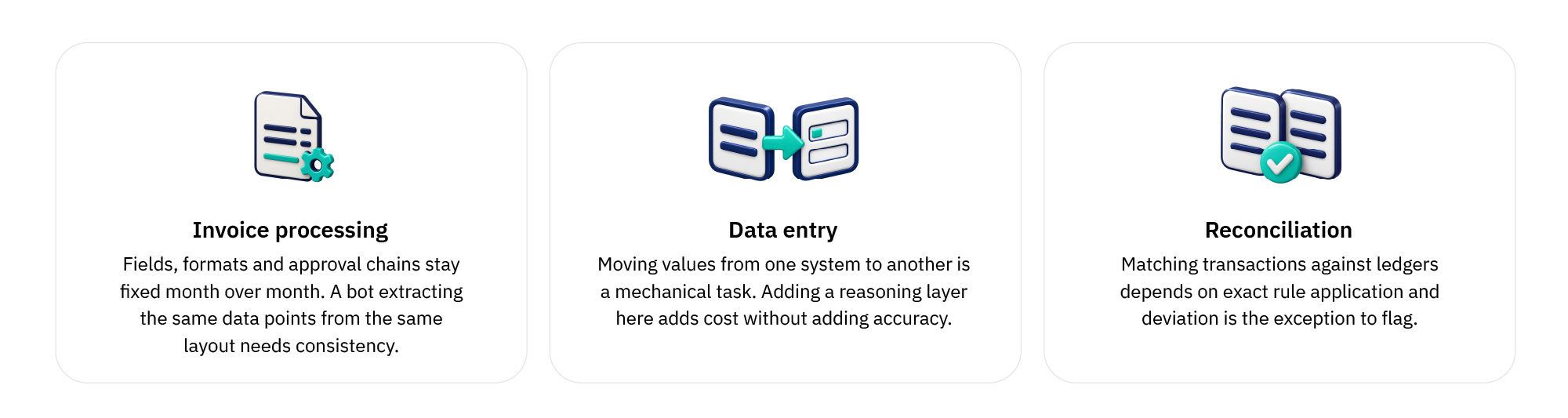
RPA is well-matched to this type of work. Adding a reasoning layer where process logic is already fixed and predictable introduces cost and complexity without a corresponding benefit.
High-Value Use Cases For Agentic AI In The Enterprise
Four enterprise functions are well-suited to agentic AI because the appropriate next action depends on context that varies with each case:
- Customer service triage is one. A support query can branch in dozens of directions depending on account history, sentiment and prior tickets. An agentic system reads that context and routes or resolves accordingly, handling branching scenarios that a single fixed workflow cannot fully anticipate.
- IT operations is another. When an incident occurs, the cause isn’t known in advance. An agent can pull logs, correlate them across systems and narrow down root cause faster than a human working through a checklist manually.
- Supply chain exception handling follows the same logic. A shipment delay, a supplier shortfall and a demand spike each require a different response, decided in real time rather than pre-scripted.
Transaction patterns shift as fraud techniques evolve, and agentic systems can adapt to new patterns as they emerge rather than relying solely on predefined rules.
Why Most Enterprises Will Run Both Systems Together
RPA and agentic AI are frequently deployed together rather than as alternatives. In practice, they sit on different layers of the same workflow.
RPA handles the deterministic layer with the fixed, repeatable steps that don’t require judgment. Agentic AI sits above it, managing orchestration and stepping in when a process hits an exception the script wasn’t built to handle. One executes, and the other decides what to execute next when the situation shifts.
This combined approach aligns with the hyperautomation model, the coordinated use of multiple technologies including AI, machine learning and RPA to automate end-to-end business processes. RPA handles the deterministic layer. Agentic AI manages orchestration and exception-handling when the situation requires judgment rather than execution.
For an executive, the practical implication is that the question isn’t RPA or agentic AI. It’s which layer of a given process needs which capability, and how the two are orchestrated to work together rather than in isolation.
Five Factors That Determine The Right Fit
Five factors help determine which approach is better suited to a given process:
| Factor | Favours RPA | Favours Agentic AI |
| Process variability | Fixed and repeatable sequence | Frequent deviations and no single path |
| Data structure | Structured and template-based input | Unstructured text, documents and conversation |
| Regulatory exposure | Requires a simple and fully logged trail | Requires a reasoning trail with built-in audit logging |
| Automation maturity | Starting from scratch with no automation base | Mature RPA estate already in place to build on |
| Talent or skills readiness | Team trained on rule-based systems | Team equipped to monitor reasoning-based systems |
RPA and agentic AI are two tools suited to different layers of enterprise work. RPA still delivers where processes are structured, stable and audit-heavy. Agentic AI earns its place where decisions shift with context, and no fixed script can cover every case. The mapping question of which layer each process needs and how the two are orchestrated together tends to produce more reliable outcomes than selecting a single technology to apply across all automation initiatives.