
Public cloud spending is forecast to reach $723.4 billion, with enterprises directing a growing share of that budget toward migration programmes. The outcomes of these programmes vary significantly, influenced by how thoroughly business cases are documented, how dependencies are mapped and how governance and security are integrated into the migration plan.
Identify eight migration mistakes that consistently affect cost, uptime and security at the enterprise level and the planning decisions that address each one.
Cloud migration outcomes are largely determined before the first workload moves, by how thoroughly the business case, dependency map, governance structure and security requirements are defined at the planning stage.
1. Migrating without a clear ROI model
Cloud migration budgets are sometimes approved before specific financial targets are defined. Without documented metrics like infrastructure cost reduction, deployment speed improvement or downtime hours saved, it becomes difficult to measure outcomes against the original business case or to course-correct if spend exceeds forecast.
The state of the cloud report found that organizations expect cloud spend to rise by an average of 28%. This makes early financial alignment between IT and finance teams a more important planning step than it may have been at earlier stages of cloud adoption.
Defining the ROI model before migration starts, with named review checkpoints to compare actual results against projections gives leadership a basis for evaluating whether the programme is delivering its intended value.
2. Underestimating Total Cost of Ownership (TCO)
Cloud TCO models that are built on list prices from a provider’s pricing calculator frequently exclude costs that become significant at scale. Data transfer between regions, unused reserved instances and on-premises software licenses that do not map directly to cloud consumption models.
The financial gap typically becomes visible after workloads move, when the monthly bill reflects costs that were not included in the original forecast. Organizations are exceeding cloud budgets by 17% on average, with 27% of total cloud spend continuing to be wasted.
Building TCO models that include data transfer, storage tiers, licensing terms and idle-resource risk before migration begins with regular cost reviews and a named FinOps owner accountable for tracking actual spend against the model. It is ideal to address this at the planning stage rather than after costs have already accumulated.
3. Lift and shift without rearchitecting
When applications are moved to the cloud without changes to their architecture, including the same monolithic structure, fixed server sizing and manual scaling processes, the cost profile from the on-premises environment largely carries over. Applications in this state do not take advantage of autoscaling, serverless components or managed services that reduce cloud costs over time.
The decision to rehost rather than rearchitect is often driven by timeline pressures like data centre lease expirations or hardware end-of-life, where speed takes priority over redesign.
Assessing each application against its usage variability and growth potential before migration allows teams to identify where rehosting is appropriate and where refactoring would reduce the long-term cost of running that workload in the cloud.
4. Ignoring data gravity and dependency mapping
Post-migration outages frequently trace back to incomplete dependency mapping rather than infrastructure failures. When discovery efforts document servers and infrastructure without mapping the connections between applications, APIs, databases and authentication services, dependencies that were not captured during planning can surface as broken workflows after go-live. This is particularly relevant for integrations that were built informally or are not fully documented in existing architecture records.
Building a complete dependency map before migration, cross-referenced against network flow logs and validated with application owners reduces the risk of post-migration connectivity issues. Migrating in waves grouped by dependency allows each set of connected systems to be tested together before the next wave begins.
5. Weak cloud governance and FinOps discipline
When cloud access is granted before tagging policies, budget ownership and approval workflows are in place, cost attribution and resource accountability become difficult to establish retroactively. Business units provisioning resources independently without a shared governance framework can result in spend that is difficult to allocate, track or review against business outcomes.
Establishing a tagging policy of covering owner, business unit, environment and cost centre before workloads move provides the attribution foundation that FinOps practices depend on. Assigning a named FinOps owner accountable for regular spend reviews by business unit keeps cost visibility active after migration rather than allowing it to drift.
6. Treating security and compliance as an afterthought
Security and compliance gaps in cloud migrations often originate at the planning stage, when access controls, encryption standards and audit requirements are not defined until workloads are ready to move rather than before. Storage configurations may carry over without access restrictions reviewed. Identity permissions established for on-premises environments may not translate cleanly to cloud access models. Involving security and compliance teams from the planning stage, with access controls and audit requirements defined as design inputs rather than post-migration checklist items reduces the likelihood of gaps surfacing during a compliance audit after go-live.
7. Underinvesting in change management and skills
Skills and change management gaps can affect how much value a cloud migration delivers after go-live. When training budgets are reduced during project cost overruns or scheduled after migration rather than before, operations teams may continue applying on-premises practices to cloud environments, reducing the efficiency gains the migration was intended to deliver.
IDC projects that more than 90% of organizations will face IT skills shortages at an estimated cost of $5.5 trillion. Planning role-specific training for cloud-native operations before migration begins and assigning change management ownership to support adoption addresses this as a programme requirement rather than a post-migration correction.
8. Vendor lock in left unaddressed
Vendor lock-in risk tends to increase when migration decisions are made primarily on speed and simplicity, where selecting one provider is faster than architecting for portability. The risk is compounded when ownership of vendor strategy is not assigned after migration is declared complete, leaving contract terms, exit plans and data portability untested until they are needed.
Assigning a named owner for cloud vendor strategy, negotiating data portability terms before migration and using cloud-agnostic tools and containerization where feasible are the practices that keep this risk manageable as the provider relationship evolves.
What successful migrations have in common
Cloud migrations that deliver consistent business value tend to share a common characteristic of governance, cost accountability, security and skills planning built into the programme from the outset rather than addressed after workloads have moved. Setting measurable targets, assigning accountable owners at each stage and revisiting decisions as workloads and business needs evolve are the practices that keep a migration programme aligned with its original business case. The planning discipline behind those practices, more than any specific tool or architecture choice determines the long-term operational and financial outcome of a migration.
A pre-migration checklist
The following checklist covers the eight planning areas most likely to affect migration outcomes:
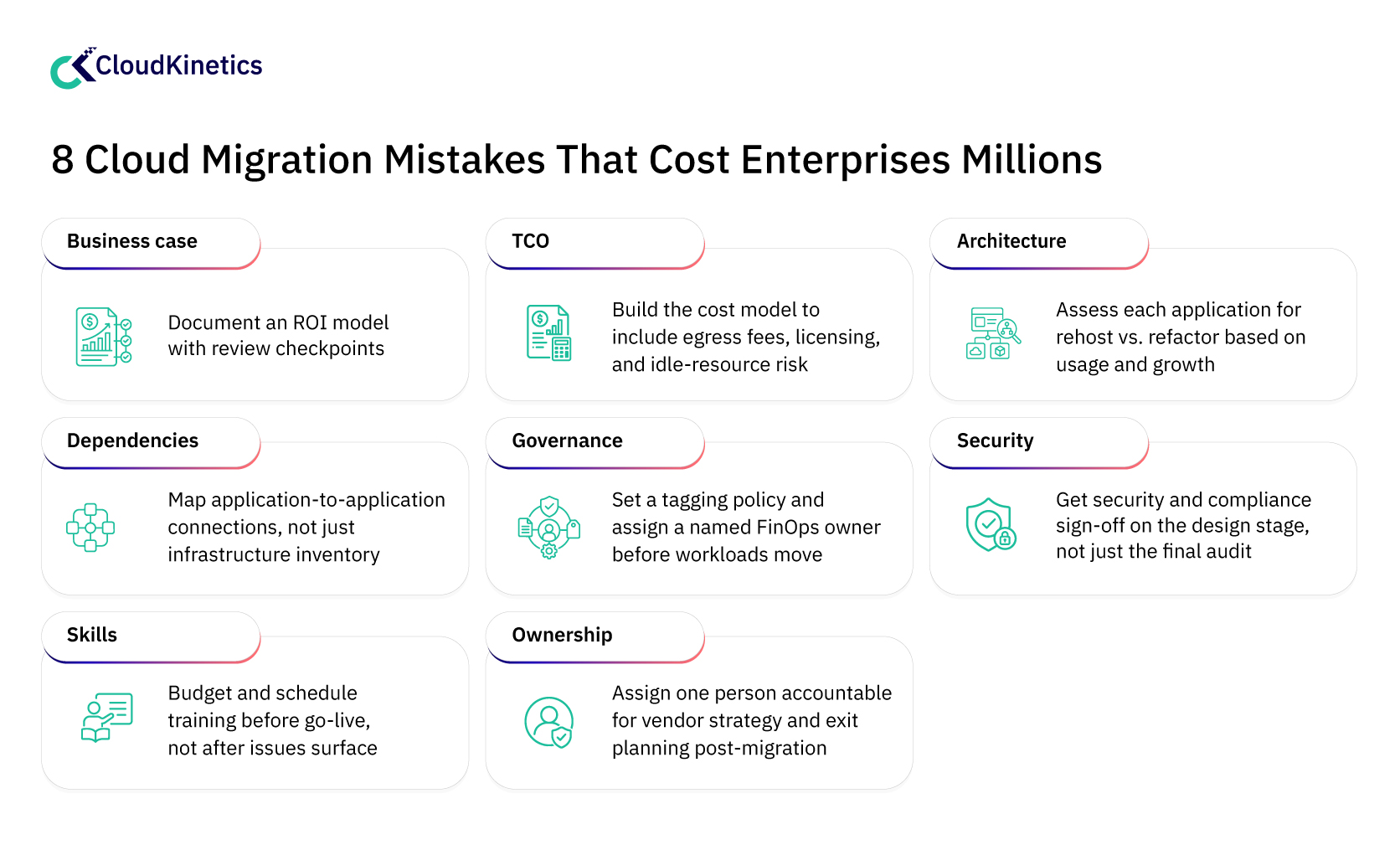
Each of these eight mistakes is addressable at the planning stage. The migration programmes that deliver against their business cases are those where cost accountability, dependency mapping, governance and security are defined as design requirements rather than post-migration considerations.