Every year, enterprises maintain a carefully curated budget for all their cloud spending. But often, they end up spending more. It is not that the cloud pricing of “pay as you go” is a myth. The root cause is often unidentified charges quietly accumulating in the background, invisible until they have already done the damage.
Understanding these invisible budget drains helps not just in maintaining financial hygiene, but in optimizing cloud operations better. Here’s a go-to resource for identifying the gaps in cloud cost management and fixing them, so every dollar you invest in the cloud actually works for your business.
Each month, 76% of large enterprises spend more than $5 million on the cloud. The numbers keep climbing, even when budgets say otherwise.
Why are cloud costs hard to control?
Almost 85% enterprises face challenges in managing cloud spending. Yet the problem isn’t the cloud itself, but the complexity that comes with it. As infrastructure expands across teams and geographies, costs become harder to track. As a result, budgets overrun, waste compounds and, by the time anyone notices, the damage is already done.
Here are some of the challenges that enterprises face in managing cloud costs:
1. Overprovisioning and idle resources
Resources get spun up for a project, and when it ends, the copy can still keep running quietly in the background. Idle or underused resources combined with overprovisioned resources are the top causes of cloud waste. Ask yourself, what is the point of allocating more resources than required?
2. Lack of cost visibility
Many enterprises don’t have a unified view of where cloud spending is going. Without it, no single team has the complete picture, and that gap creates friction between different teams and blind spots that compound over time. This is precisely where a structured cloud FinOps practice becomes critical, one that assigns clear accountability across teams and ensures cost visibility is no longer left to chance.
3. Misaligned ownership between engineering and finance teams
When it comes to cloud spend management, the role of engineering and finance is crucial. Although the two teams operate in separate worlds with no shared accountability, by the time finance flags an overspend, engineering has already moved on to the next sprint. Effective cloud cost management requires real-time data and collaboration, which only works if both teams are operating together.
4. Multi-cloud complexity
When enterprises use multiple cloud systems, the complexity, along with cost management challenges increases. Managing cost across different providers can create many blind spots, where optimizing cloud can get difficult. Bringing unified visibility across different environments thus becomes a necessity.
5. Reactive cost management
Often, enterprises only address cloud costs after something goes wrong. It can be when a surprise bill arrives or when the CFO starts asking questions. This reactive and crisis-driven approach drains engineering time into firefighting rather than innovating. The shift from reactive to proactive is what separates organizations that control their cloud spend from those that are controlled by it.
Enterprise cloud cost management strategies
When you know where your money is going and why, managing cloud costs becomes more straightforward. Here are some strategies you can adopt to gain control and get measurable value from every dollar spent on the cloud.
1. Adopt a FinOps framework to drive cross-team cost accountability
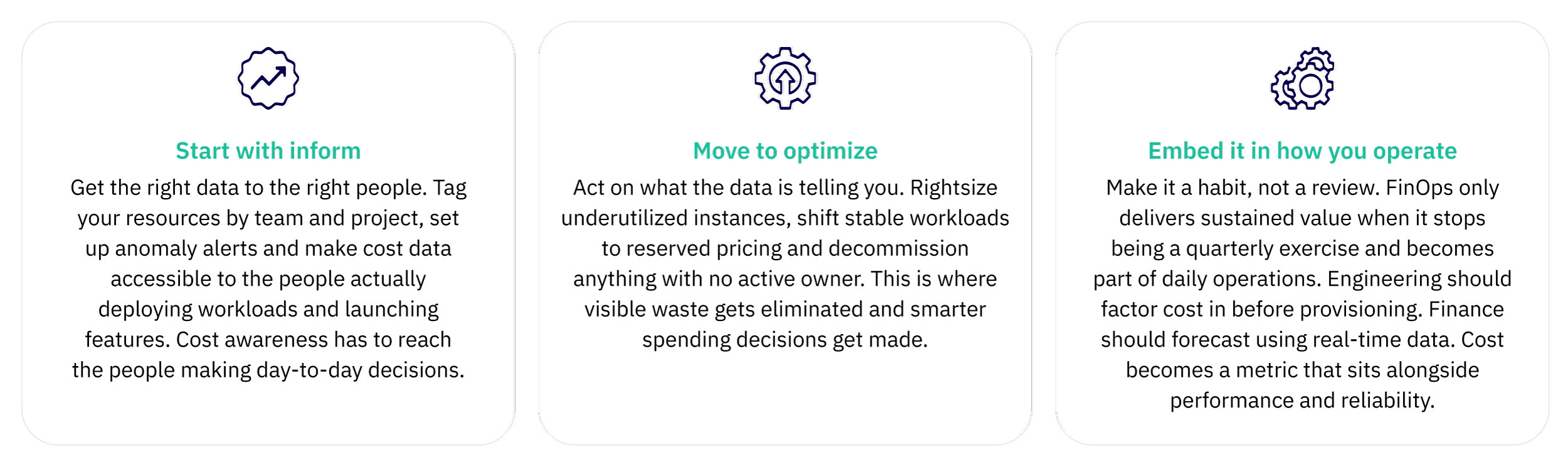
While cloud cost challenges stem from multiple factors, poor visibility is often at the core. When teams can’t see where spending is going, it becomes difficult to control, allocate or optimize it effectively. The answer lies in adopting FinOps as a structured operating model that embeds cost accountability into how your teams work every day.
To put it into practice, work through its three continuous phases:
2. Use showback to build awareness, then shift to chargeback for ownership
The strategy here is not to pick one or the other, but to know when to use each and how to progress between them. If you are early in your FinOps journey, start with showback. It surfaces cost consumption by team or project without billing anyone directly. This makes it a low-friction way to build awareness and get teams comfortable seeing what their cloud usage actually costs.
As your practice matures and spending becomes more distributed, move toward chargeback. When each team owns its slice of the bill, it naturally drives more deliberate provisioning decisions and reduces waste at the source.
The progression matters and enterprises that jump straight to chargeback without laying the groundwork often face pushback because teams don’t have the visibility or context to act on the data. Showback builds that foundation first.
3. Unify visibility and governance across multi-cloud environments
Managing costs across multiple providers adds complexity that demands a deliberate strategy. Start by establishing a single, consolidated view of spending across all clouds. Without it, cost allocation becomes guesswork.
From there, apply consistent tagging standards across every environment. Be deliberate about workload placement by matching compute-heavy tasks to providers with stronger CPU and GPU pricing. And review reserved instance coverage across all providers together. This last step alone prevents the common pitfall of over-committing on one cloud while overspending on-demand on another.
4. Treat AI and GenAI workloads as a separate cost category
AI workloads are expensive and unpredictable. A single training job can consume massive compute and rack up costs faster than any alert can catch it. Unlike traditional cloud resources, they scale rapidly and don’t follow predictable usage patterns, making them particularly difficult to govern without a deliberate strategy.
With AI spending estimated to reach $1.6 Trillion in 2031, most enterprises are scaling fast but without a clear view of what is actually driving those numbers. Lumping AI costs into general cloud spend is where visibility breaks down and waste compounds silently.
The fix starts with treating AI and GenAI as a distinct cost category entirely. Tag and monitor these workloads independently so you always know what they are costing and why. Right-size model selection the way you would right-size compute instances, as not every job needs the most powerful or most expensive model available. Establish a cost-per-output baseline before scaling, because scaling an inefficient workload only amplifies the problem. Finally, put guardrails in place upfront: budget thresholds, usage alerts and approval workflows for large training jobs should be built into the process, not added after costs have already spiraled.
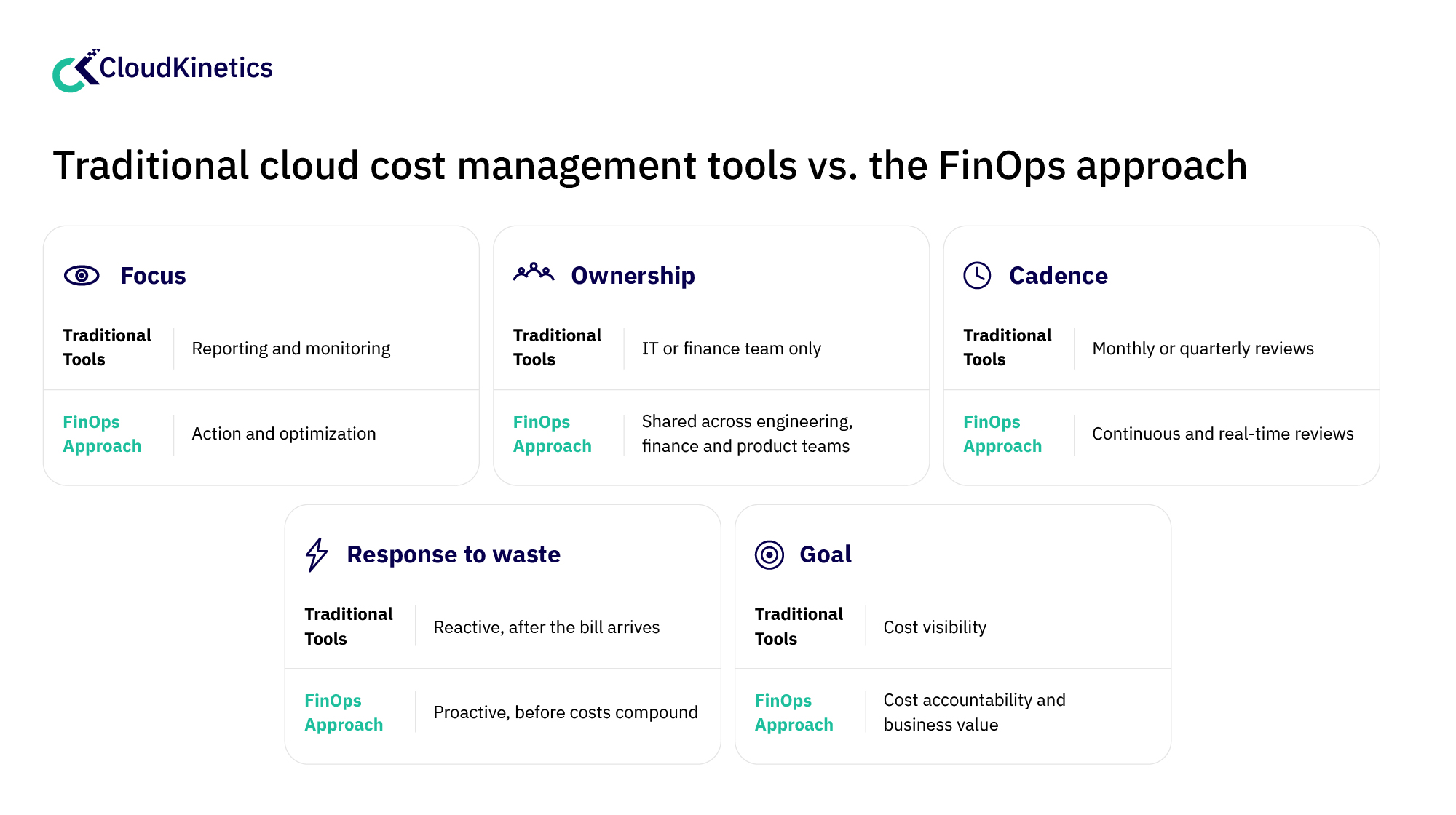
Managing cloud costs is not a one-time fix. It is a continuous discipline that requires visibility, cross-team collaboration and the right frameworks embedded into everyday operations. The enterprises that stay ahead of their cloud spend are the ones that treat cost as a shared responsibility. The engineering, finance and product teams should be aligned around the same data and the same goals.
Start with visibility, build accountability structures around it and keep optimizing as your cloud environment evolves. When cost awareness becomes a habit rather than a reaction, smarter spending follows naturally.