Nearly 97% of executives report their organization have deployed AI agents. Also, 61% of CEOs globally confirm they are actively adopting AI agents and preparing to implement at scale.
That scale of deployment changes the nature of the risk conversation. When AI was advisory, a wrong output could be caught before any action was taken. When AI is autonomous, the action and its consequences can precede the review, moving agent security out of IT’s remit.
AI tools have been designed to assist in summarizing documents, surfacing insights and supporting decisions. AI agents extend beyond that. They invoke APIs, trigger workflows and execute transactions across multiple systems, without human approval at each step.
Why existing security models were not built for AI agents
Enterprise security models were built around human users, where a person logs in, performs a task and logs off. AI agents operate differently. They run continuously, take actions at machine speed and can generate sub-agents to handle parts of a task independently. This places them in a category distinct from both traditional software and human users, one that existing identity and access frameworks were not originally designed to address.
AI agents take actions, and the damage follows before the review does. The enterprises that build governance into their agent architecture from the start will scale without losing control.
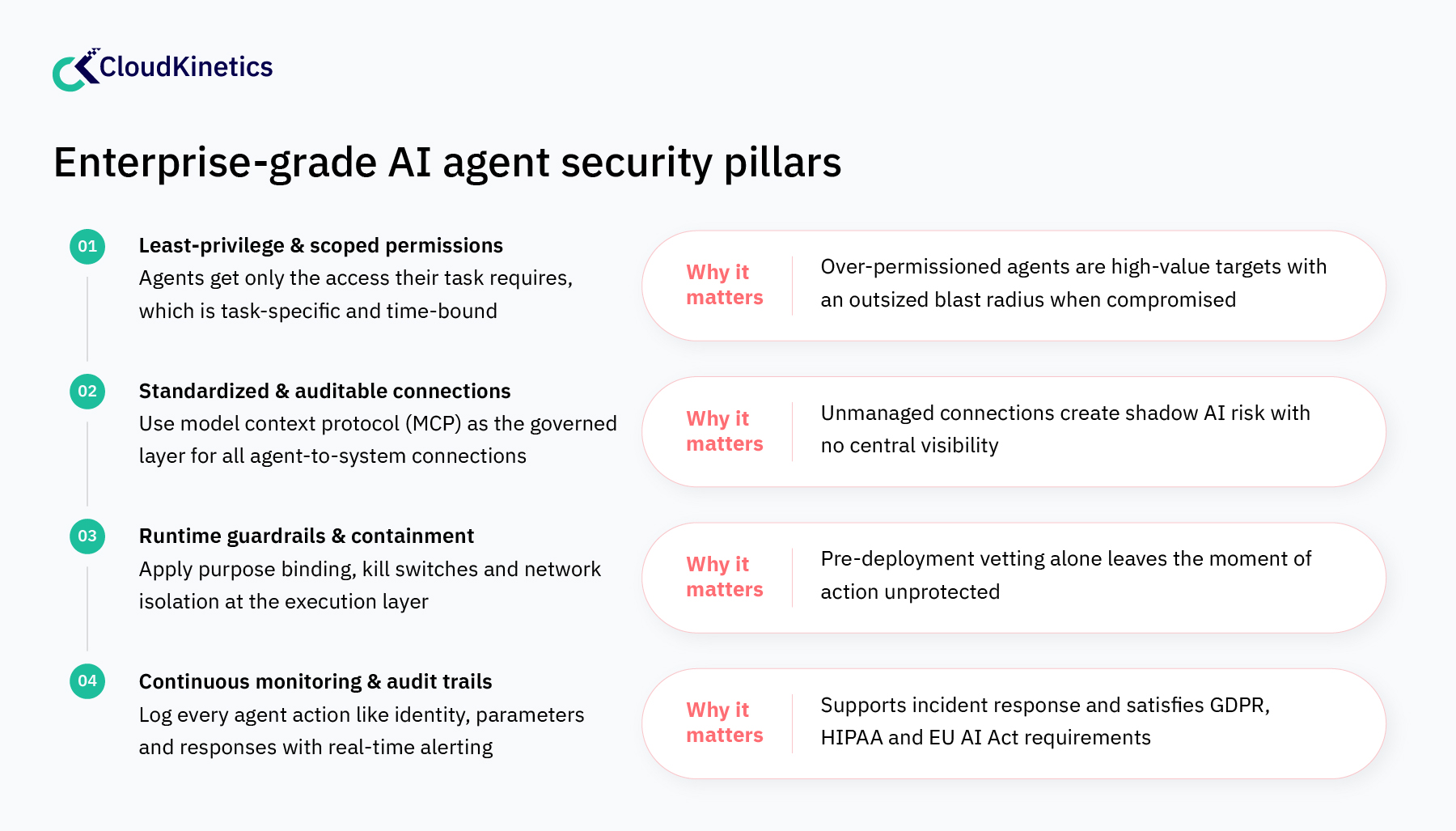
In many deployments, agents inherit the access permissions of the human user or service account that deployed them. That access is rarely revisited at the pace agents actually operate. This creates a gap between what agents are permitted to do and what they were intended to do. A quarterly access review, built for a world where roles change slowly, simply cannot keep up with an entity that can take hundreds of actions before the next review cycle even begins.
According to research on agentic enterprises, organizations are increasingly managing thousands of these non-human identities, often operating outside the human-centric controls security teams have relied on for years. This is best understood as a governance and identity problem, as well as a technical one.
4 risk areas that existing security controls don’t cover
- Privilege escalation and tool misuse
Agents are typically granted broad access at deployment, with the intention of tightening permissions later. In many deployments, permissions set at launch remain unchanged through the agent’s operational life. Agents operating with over-permissioned credentials become high-value targets, where a single compromised agent can cause damage that would otherwise require compromising dozens of individual human accounts. The access controls governing agents are set at the network level. If an agent has API access to a system, the firewall permits any query from it, regardless of whether that query was intended.
- Prompt injection as an attack vector
Unlike attacks that exploit code vulnerabilities or stolen credentials, AI agents can be compromised through the content they are designed to process. A single sentence embedded in a retrieved document, webpage or code comment can redirect an agent’s behaviour or trigger unauthorized system actions, with no malware and stolen credentials involved.
- The governance-containment gap
Most organizations can monitor what their AI agents are doing, but the risk lies in stopping them when something goes wrong. This governance-containment gap is a security challenge, as agents gain increasing access to enterprise systems.
According to another research report, 55% to 63% of organizations lack purpose binding, kill switches or network isolation for their AI agents. This means that organizations have invested in watching agents, but not in stopping them.
- Agent sprawl
The active enterprise deployers are already running 76-100 agents and doubling that count every quarter. The governance frameworks needed to manage this growth are not keeping pace with deployment speed and create a widening blind spot for security teams.
Key frameworks shaping enterprise AI agent governance
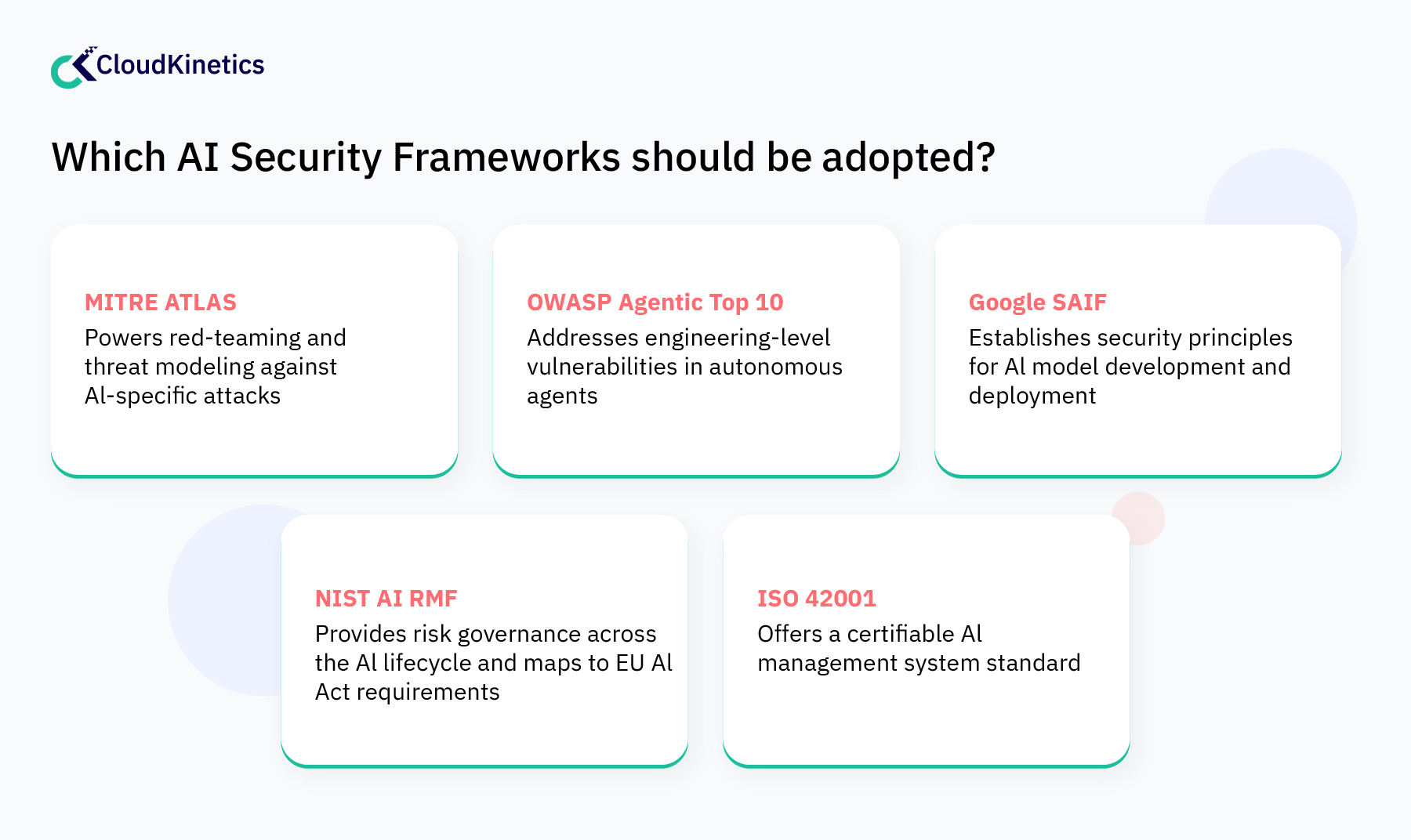
There is no single framework that covers AI agent security end-to-end. Each addresses a different layer of the AI security problem and they need to be used together for comprehensive coverage.
This includes:
- NIST AI Risk Management Framework (AI RMF) provides the governance model
- Open Worldwide Application Security Project (OWASP) serves as the engineering baseline
- MITRE Adversarial Threat Landscape for Artificial-Intelligence Systems (ATLAS) supports threat modeling
- ISO 42001 handles external verification
- Google’s Secure AI Framework (SAIF) guides secure model development
The enterprise frameworks behind AI agent security
With the EU AI Act in active enforcement, mapping agent deployments to a recognized governance framework is becoming a baseline compliance requirement for high-risk AI applications.
5 steps to start governing AI agents today
- Build a complete agent inventory
Governance controls only function when applied to a complete and accurate inventory of agents. This includes agents built internally, those embedded in SaaS platforms and any deployed by individual teams without central security review. Under the EU AI Act, for instance, an incomplete AI system inventory is a compliance violation, regardless of whether the tools were known to exist.
- Classify by access level and business criticality
Once inventoried, agents should be classified by the sensitivity of the systems they can access and the business impact if they malfunction or are compromised. This classification determines which agents require the strictest controls and most urgent remediation.
- Implement scoped, revocable credentials before scaling
Every agent should operate with the minimum permissions needed to complete its task. Credentials should be time-bound and revocable, so that access can be withdrawn immediately if an agent’s behaviour deviates or a security event occurs.
- Define thresholds for autonomous action vs. human escalation
Not every action an agent takes should proceed without review. Enterprises need documented thresholds, based on risk level, data sensitivity or financial exposure. These determine when an agent must pause and escalate to a human decision-maker.
- Assign ownership to security
Agent governance requires a named executive owner within the security function, like someone accountable for maintaining the access log, managing the accountability chain and making decisions when agent behavior deviates from expected parameters.
Security is what makes scaling agentic AI possible
Enterprises that have established agent governance are not slowing down their AI deployment. They are scaling it with less exposure and greater confidence when regulators or clients ask how autonomous AI is being managed.
Governance built early becomes part of the architecture, not an overhead layer added after deployment has already scaled. Security, in this context, is the foundation that determines how far and how safely an enterprise can go.