
Forecast accuracy has direct implications for use cases as varied as managing working capital, optimizing energy costs and planning capacity. When a demand forecast is inaccurate, the result is either excess inventory or stockouts. When an energy forecast is inaccurate, operating costs increase or grid capacity is strained. These outcomes connect forecasting decisions to financial and operational performance at the enterprise level.
Modern forecasting architectures are transitioning from static, periodic reporting to automated, self-correcting pipelines. Beyond purely technical considerations, key decisions regarding cloud platform selection, retraining governance, and workload automation now directly impact enterprise infrastructure and budgeting strategy.
As forecasting moves from fixed refresh cycles to continuous agentic pipelines, the value it delivers shifts from periodic reporting to earlier visibility into demand, cost and capacity signals, before those signals become balance sheet events.
Early forecasting methods and their limits
Early forecasting approaches relied on historical data as the primary input, using prior period figures as the basis for the next. Statistical models introduced more structure to this process. Methods like autoregressive integrated moving average (ARIMA) incorporated trend, seasonality and past error terms into the calculation, making forecasts more repeatable and less dependent on individual judgment. Statistical models perform well in contexts with clean, well-structured data and stable patterns.
As datasets grew in volume and complexity and as irregular demand patterns became more common, machine learning-based approaches offered additional capabilities that statistical methods were not designed to provide.
Amazon Forecast: Which algorithm fits which data
Amazon Forecast provides six built-in algorithms for time-series prediction. This includes ARIMA, exponential smoothing (ETS), Prophet, non-parametric time series (NPTS), DeepAR+ and convolutional neural network – quantile regression (CNN-QR).
ARIMA, ETS, Prophet and NPTS are local models, trained on one time series at a time. DeepAR+ and CNN-QR are global models, trained across multiple time series at once, allowing them to learn patterns shared between related items. Forecast also offers an automated machine learning (AutoML) option that tests the built-in algorithms and selects the one with the lowest error across quantiles.
| Algorithm | Best suited for |
| ARIMA | Simple datasets, under 100 time series |
| ETS | Simple datasets with clear trend and seasonality |
| Prophet | Strong seasonal patterns, several seasons of history |
| NPTS | Sparse or intermittent data with many zero values |
| DeepAR+ | Hundreds of related time series, shared demand patterns |
| CNN-QR | Large datasets with item metadata and related time series |
ARIMA and ETS work for simple datasets under 100 time series, Prophet suits data with strong seasonal effects and several seasons of history, and NPTS is built for sparse or intermittent time series. CNN-QR and DeepAR+ handle larger datasets with hundreds of time series.
The rise of agentic forecasting
Many production forecasting systems operate on fixed refresh cycles, where data is extracted, a model is trained, a forecast is published and the process repeats on a scheduled interval. Agentic AI changes this model. Instead of one model producing a single number at a scheduled interval, AI agents coordinate a continuous set of tasks. This involves validating incoming data, detecting anomalies, tracing root causes and adjusting forecasts as new signals arrive.
Drift detection and automated retraining
Forecast accuracy degrades when incoming data no longer resembles the data a model was trained on, a condition known as data drift. In production ML systems, an AI agent monitors drift signals, evaluates retraining triggers and initiates pipeline execution based on predefined thresholds. This reduces the need for manual intervention at each retraining cycle while keeping the engineering team accountable for governance decisions. Drift is typically measured using statistical tests, and agentic systems select the relevant test per feature type, generate a drift score and trigger a retrain workflow once a threshold is crossed.
Anomaly classification and scenario planning
Agentic systems also categorize anomalies rather than flagging every outlier equally. These systems classify anomalies into data anomalies (missing feeds, broken hierarchies), model anomalies (bias drift, error spikes) and business anomalies (price changes, demand surges, supply constraints), then attach evidence on which signals moved first and the likely causes. This structure supports LLM-driven scenario planning, where a change in a single input, such as, freight cost can be traced through to its effect on the forecast.
Forecasting across the enterprise: Industry use cases
Retail: Demand and inventory planning
Foxconn used Amazon Forecast to replace customer-supplied demand estimates that had become unreliable. The implementation, covering data import, model training and evaluation, took six weeks and delivered an 8% forecast accuracy improvement. This translated to an estimated $553,000 in annual savings.
According to McKinsey, across the retail sector, AI-based forecasting improves accuracy by 10-20%, which translates to revenue increases of 2-3%.
Cloud financial operations
Cloud Kinetics, recognised by AWS as an Amazon Forecast Partner for Asia Pacific, has applied the approach to cloud spend forecasting. The company integrated Amazon Forecast into its Cloud Management Platform, Arcus, giving clients a three-month forward view of cloud spend across regions, services and cost tags. Cloud Kinetics has built prediction models for several customers, including a major bank in Thailand. Its cloud spend forecasting feature has helped business decision-makers budget IT spend with confidence based on their own usage patterns.
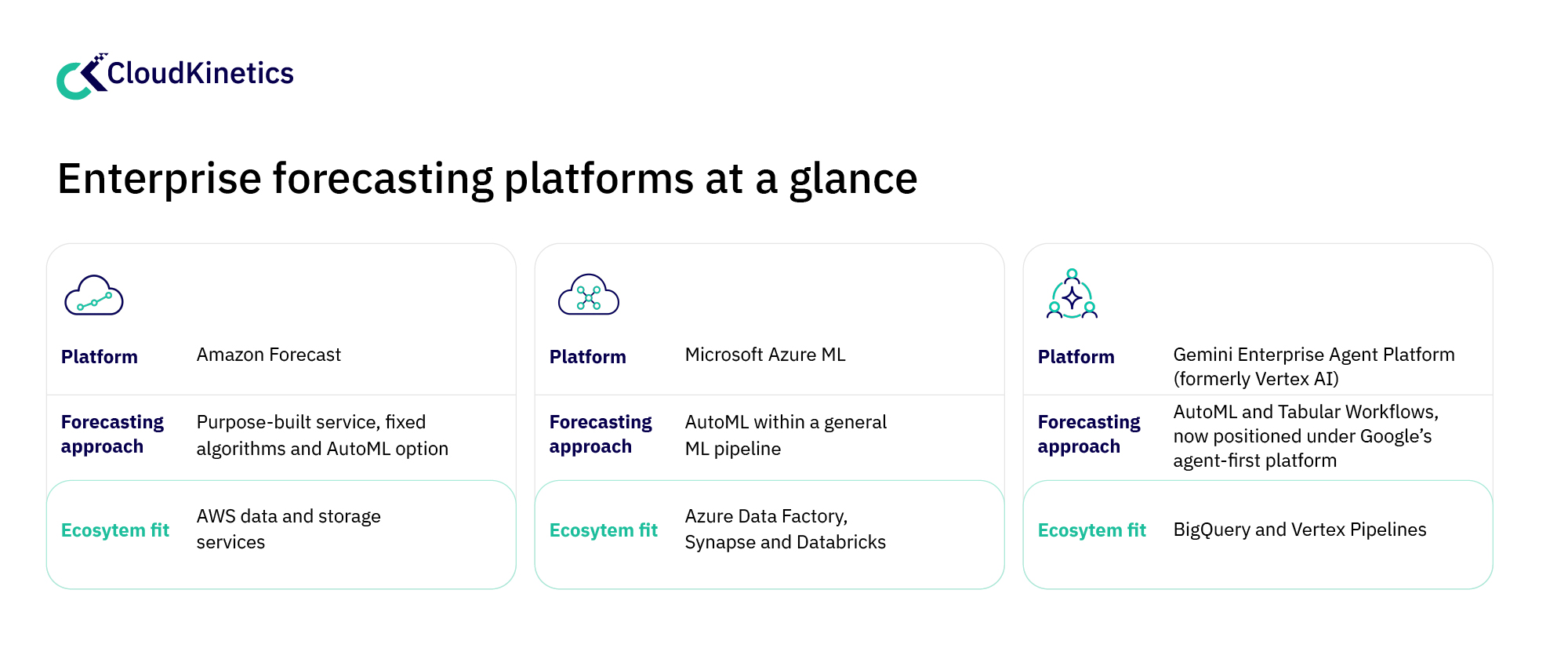
Amazon Forecast vs. Azure vs. Gemini Enterprise AI Platform
Amazon Forecast is a purpose-built forecasting service with fixed algorithms and an AutoML option. It supports probabilistic forecasting and combines time series data with external variables. AWS now directs new users toward Amazon SageMaker Canvas, since Forecast is in legacy status and receives only security, availability and performance updates
Azure does not offer a standalone forecasting product. Forecasting runs through Azure Machine Learning’s AutoML capability. AutoML in Azure Machine Learning combines standard machine learning models with established time-series models, using historical target data along with user-provided and automatically engineered features. This ties forecasting into the broader Azure ML pipeline, including compute clusters and MLOps components.
Gemini Enterprise Agent Platform (formerly Vertex AI) offers forecasting through AutoML and Tabular Workflows. Model choices include the Temporal Fusion Transformer for accuracy and interpretability, AutoML (L2L) for general use cases and Seq2Seq+ for faster experimentation on smaller datasets. Existing Vertex AI APIs, including AutoML and the Model Registry, remain functional under the new platform name.
Governance and readiness for agentic forecasting
A forecasting model is only as reliable as the data and governance behind it. Three considerations are relevant before onboarding a workload into a forecasting platform: a clear definition of the business problem the forecast is intended to address, sufficient historical and related time-series data to support model training and a governance structure for monitoring model drift over time.
Agentic pipelines add a further governance dimension by defining when an agent can trigger retraining autonomously and when a human review is required before a change takes effect. Establishing these controls before a model goes into production, including data quality checks, drift thresholds and approval workflows supports forecast accuracy and auditability as the deployment scales.